
Workflow for rapid parcel delivery: a practical guide
- Andrew Buttrick
- May 21
- 7 min read
TL;DR:
Effective rapid parcel delivery relies on accurate data, standardised scan events, and integrated technology tools.
Active exception management, proactive communication, and continuous KPI measurement are essential for operational resilience.
Getting the workflow for rapid parcel delivery right is one of the most pressing operational challenges facing logistics managers and business owners today. Demand for same-day and next-day services is rising sharply, and customers now expect real-time visibility alongside fast transit. When the process breaks down, the consequences are direct: failed deliveries, increased support costs, and reputational damage. This guide covers everything from pre-dispatch preparation through to execution, exception handling, and continuous improvement, so you can build a process that holds up under pressure.
Table of Contents
Key takeaways
Point | Details |
Prepare before you dispatch | Accurate address data and standardised scan events are the foundation of a reliable rapid delivery workflow. |
Use dynamic route planning | AI-driven routing reduces travel distance and manual workload, improving on-time performance across your fleet. |
Monitor exceptions actively | Poll carrier APIs every 30 to 60 minutes for urgent shipments to catch issues before they breach delivery promises. |
Communicate proactively | Clear, milestone-based notifications reduce WISMO enquiries by 25 to 40%, cutting support costs significantly. |
Measure and iterate | Track on-time rates, first-attempt success, and cost per delivery to identify where the workflow needs adjustment. |
Building a workflow for rapid parcel delivery
Before a single parcel leaves your facility, the foundations of an efficient parcel delivery process must already be in place. Skipping preparation is the single most common reason rapid deliveries fail, and it is nearly always avoidable.
Data accuracy is non-negotiable. Every order must carry a verified delivery address, correct postcode, and accurate parcel dimensions before it enters the dispatch queue. A single address error can collapse an entire same-day run. Beyond that, standardised scan events create the reliable tracking data and internal accountability that rapid delivery workflows depend on. Without consistent scan milestones at collection, in-transit, and delivery stages, automated issue detection becomes impossible.
The technology stack also matters. You need at minimum:
Real-time GPS tracking integrated with your transport management system
Dynamic route optimisation software capable of adjusting mid-run
Carrier API integrations for live status polling
An automated notification platform for customer-facing updates
Pro Tip: Invest in a platform that consolidates route planning and carrier communication in one place. Switching between disconnected tools adds manual steps that slow execution under time pressure.
Standard operating procedures (SOPs) for parcel handling, exception triage, and customer communication should be documented clearly before urgent volumes increase. Your team also needs defined roles: who triages late collections, who escalates failed deliveries, and who updates customers. Without these role definitions, urgent situations create confusion rather than coordinated responses.
Requirement | Tool or practice | Why it matters |
Address verification | Address validation API | Prevents failed first-attempt deliveries |
Scan event standards | TMS or WMS with event logging | Enables automated tracking and accountability |
Route optimisation | AI routing software | Reduces mileage and improves on-time rates |
Customer notifications | Automated notification platform | Reduces WISMO enquiries |
Team role clarity | Written SOPs with escalation paths | Prevents delays during exception handling |
Step-by-step execution of the delivery process
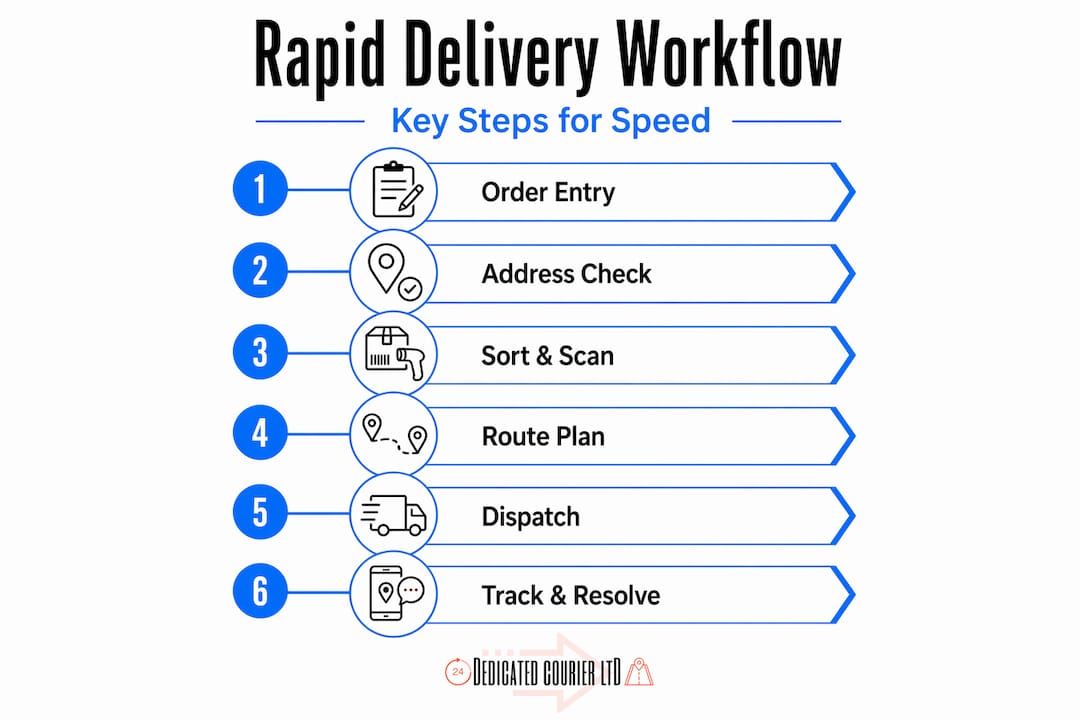
Once preparation is complete, execution follows a defined sequence. Each stage must hand off cleanly to the next to maintain the pace that rapid delivery logistics demands.
Order capture and validation. Confirm all data fields on receipt, generate a shipping label immediately, and assign the order to the correct service tier. Same-day orders must not wait in a general queue.
Inventory allocation and picking. Use priority flagging in your warehouse management system so urgent parcels are picked first. Zone-based picking reduces walk time when volumes are high.
Dynamic route planning. AI-driven routing can cut travel distance by 15 to 30% and fuel consumption by 10 to 25% in urban parcel delivery. Run route optimisation as close to dispatch time as possible to capture the most current traffic data.
Carrier dispatch and monitoring. Once the vehicle is on the road, poll carrier APIs every 30 to 60 minutes for express shipments. Standard ground shipping is monitored every two to six hours, but urgent consignments need far tighter intervals.
Proactive customer communication. Send milestone notifications at collection, in-transit, and out-for-delivery stages. Clear, action-oriented messaging reduces customer anxiety and support calls significantly. Messaging that explains status and next steps consistently outperforms messages that only provide a tracking number.
Final mile optimisation. Where your delivery density allows, use parcel lockers and micro-hubs to support sub-2-hour delivery windows. Urban micro-hubs reduce failed deliveries and lower cost per parcel over time.
Pro Tip: Requiring a signature for every consignment increases failed delivery rates. Review which shipment types genuinely need a signature and use delivery-window choices or safe-place options for the rest. Fewer failed attempts directly improves your first-attempt success rate.
Managing exceptions and delivery disruptions
Even with a well-prepared workflow, exceptions occur. Address errors, restricted access, and weather delays are part of day-to-day rapid delivery logistics. What separates a reliable operation from an unreliable one is not the absence of exceptions but how quickly and consistently they are resolved.
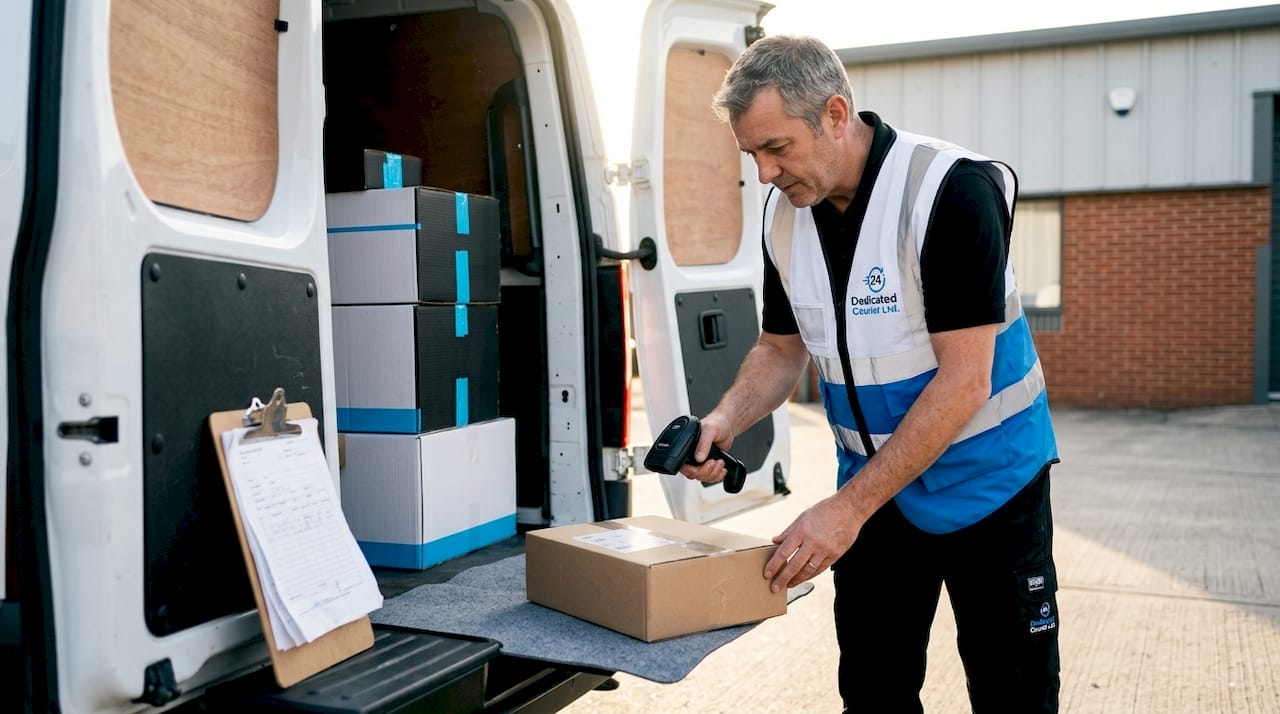
Successful exception management depends on a three-tier escalation structure: triage the issue, take direct action, and escalate only when thresholds are breached. Over-escalation floods your support team with unnecessary work and slows down actual resolution. Set clear volume and time thresholds before any issue moves to the next tier.
Automated monitoring alerts are the practical mechanism here. Configure your system to flag any scan gap above a defined interval on urgent shipments, then assign those alerts directly to your triage team rather than a general inbox. Exception SOPs should also be documented flexibly so that operational staff can update procedures without requiring engineering or IT involvement each time carrier processes change.
Exception type | Likely cause | Recommended response |
Address error | Incorrect data at order entry | Contact customer immediately, reroute if same-day window allows |
Access constraint | Gated premises or no-one home | Use driver notes system, attempt safe-place delivery |
Carrier scan gap | Vehicle off-route or system delay | Trigger automated alert, call driver within threshold window |
Weather delay | Severe conditions affecting road | Notify customer proactively, revise ETA in tracking portal |
Pro Tip: Do not investigate every flagged scan gap manually. Set a time threshold, say 90 minutes without a scan update on a same-day consignment, before triggering a driver contact. Below that threshold, automated alerts are sufficient.
Measuring and improving the delivery workflow
Execution without measurement produces no durable gains. The goal of parcel delivery optimisation is not a one-off fix but an iterative process that makes the workflow progressively more reliable and cost-effective.
The KPIs that matter most for rapid delivery operations are:
On-time delivery rate: the primary measure of whether the workflow is working
First-attempt success rate: a direct indicator of data quality and customer communication effectiveness
WISMO ticket volume: omnichannel event-driven notifications reduce these enquiries by 25 to 40% when implemented correctly
Cost per delivery: tracks whether route and density improvements are converting to financial gains
Machine learning feedback loops embedded in modern route optimisation platforms continuously refine promise accuracy and routing decisions based on historical delivery data. Proof-of-delivery records, combined with customer satisfaction scores, give you the ground-level evidence needed to adjust SOPs. Regular scorecard reviews, whether weekly or fortnightly, prevent the workflow from drifting back into ad-hoc practices. You can find further detail on structuring these reviews in this guide to urgent UK shipments.
Multi-carrier orchestration also adds resilience. When one carrier experiences delays or capacity issues, an orchestrated workflow automatically routes to an alternative, maintaining delivery promises without manual intervention.
My honest take on making this work
I’ve seen businesses invest heavily in route optimisation software and then underestimate how much of the problem is actually a communication failure rather than a routing one. WISMO is a communication failure as much as a shipping failure. The operations that genuinely outperform their peers are the ones that treat customer updates with the same rigour as route planning.
Dynamic routing genuinely transformed the workload I observed for one logistics team. The hours saved on manual planning freed dispatchers to focus on exceptions rather than constantly rebuilding routes. But the change management side of it was harder than expected. Driver buy-in took time. Some drivers resisted the adjusted routes initially because they disrupted familiar patterns. Without sustained effort to explain the reasoning, adoption would have been partial.
The uncomfortable truth about cost control is that same-day speed and the lowest possible cost per delivery are in tension. You can optimise one or the other more aggressively, but trying to maximise both simultaneously without the right delivery density usually leads to cutting corners on monitoring, which is where reliability suffers. Know which priority dominates in your operation and build the workflow accordingly.
— andrew
Ready to put the workflow into practice?
If you want to take the next step from planning to execution, Dedicatedsamedaycourier offers dedicated vehicle options across the UK for urgent parcel deliveries, with 24/7 availability and nationwide coverage. Each consignment travels on an exclusive vehicle, which removes the delays associated with consolidated loads.
[
Whether you need a van for a single urgent consignment or a larger vehicle for time-critical pallets, you can explore the full range of courier vehicle options or get a tailored quote directly through the Dedicatedsamedaycourier same-day courier service. The platform operates around the clock, so urgent requests can be handled at any time, including overnight and weekend collections.
FAQ
What is the most important step in a rapid parcel delivery workflow?
Accurate order data and standardised scan events at every stage are the most critical foundations. Without these, automated monitoring and dynamic routing cannot function reliably.
How often should carrier APIs be polled for urgent deliveries?
For express and same-day consignments, carrier APIs should be polled every 30 to 60 minutes to detect exceptions before they breach delivery promises.
How can businesses reduce WISMO enquiries in rapid delivery operations?
Implementing automated, omnichannel milestone notifications at collection, in-transit, and out-for-delivery stages reduces WISMO enquiries by 25 to 40%, according to current shipping data.
What KPIs should logistics managers track for rapid parcel delivery?
On-time delivery rate, first-attempt success rate, WISMO ticket volume, and cost per delivery are the four metrics that most directly reflect whether a rapid delivery workflow is performing well.
How does dynamic route optimisation improve delivery speed?
Dynamic route optimisation adjusts routes in real time based on traffic, access constraints, and updated delivery priorities, reducing manual workload for dispatch teams and improving on-time performance across the fleet.
Recommended


Comments