
Streamline your retailer courier workflow: 5 steps to reliability
Updated: May 14
TL;DR:
Reliable courier workflows depend on accurate addresses, proper packaging, and integrated systems.
Controlling pre-delivery factors like address verification and clear access instructions reduces failures.
Aiming for at least a 98% on-time delivery rate ensures dependable same-day logistics.
A single failed same-day delivery can cost a local retailer far more than the sale itself. Negative reviews spread quickly, repeat customers disappear, and your reputation takes a hit that discounts cannot fix. Research consistently shows that delivery experience is one of the top factors in customer loyalty decisions. A repeatable, well-structured courier workflow is not a luxury for large logistics operations; it is a practical necessity for any UK retailer sending goods out the door. This guide walks you through the exact steps, tools, and checks that make same-day courier reliability achievable and consistent.
Table of Contents
Key Takeaways
Point | Details |
Preparation is critical | Thoroughly check every order, address, and packaging before booking courier collection. |
Follow key workflow steps | A set process from order verification to proof of delivery minimises failed deliveries and boosts satisfaction. |
Avoid common mistakes | Most failures result from missing or inaccurate data—stay vigilant on details and confirmations. |
Scale smartly | Use automation and reliable partners to handle peak demand without sacrificing reliability. |
What you need to get started with a local courier workflow
Before you can run a reliable courier workflow, you need the right foundations in place. Trying to fix reliability issues mid-dispatch is far harder than preparing properly beforehand.
The core resources every local retailer needs include:
Accurate order and recipient information (full address, postcode, contact number)
Reliable, appropriate packaging matched to the goods being sent
Access to a courier booking system or direct account with a same-day provider
A label printer for clear, scannable consignment labels
An order management integration or spreadsheet that feeds dispatch data cleanly
A tracking portal so both staff and customers can monitor progress
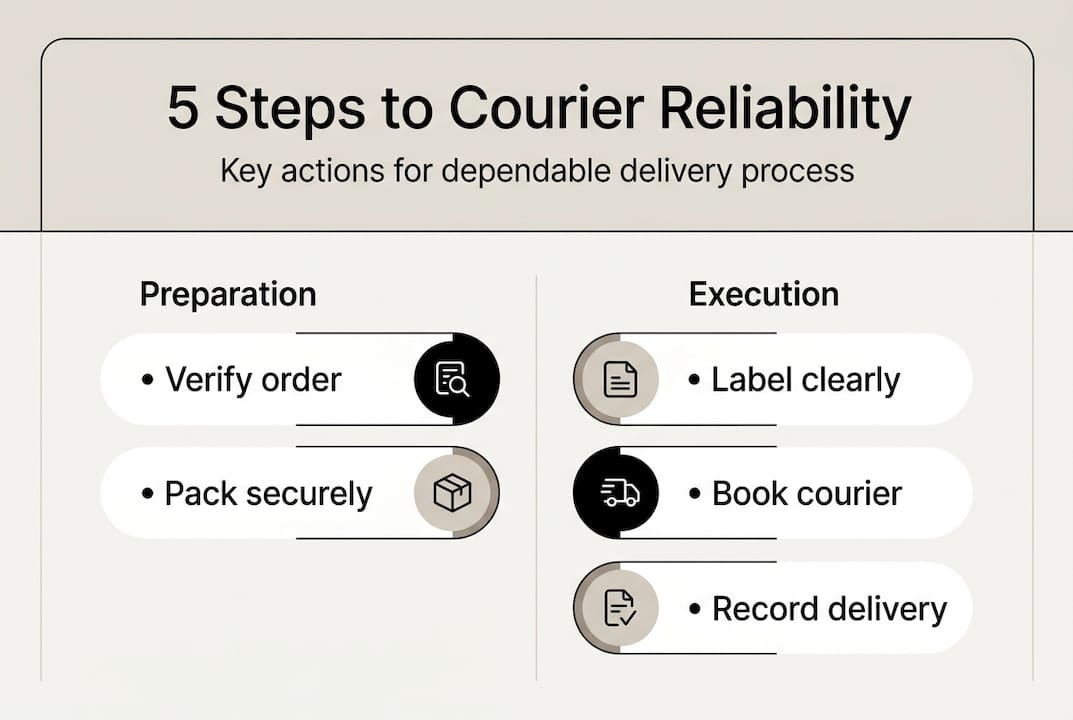
The delivery workflow overview confirms that a practical same-day courier workflow typically follows this sequence: verify order and address, package correctly, schedule pickup with access instructions, manage in-transit visibility via tracking, and confirm delivery with proof of delivery.
Requirement | Essential | Nice to have |
Label printer | Yes | |
Order management system | Yes | |
Tracking portal | Yes | |
Barcode scanner | Yes | |
Automated dispatch integration | Yes | |
Dedicated courier account | Yes |
A real UK retail case study demonstrates how even mid-sized retailers see significant reliability gains when these basics are consistently in place. You can also review the SME courier workflow for guidance tailored specifically to smaller operations.
Pro Tip: Always test your workflow during a low-pressure period before peak trading, such as a quiet Tuesday rather than a pre-Christmas week. Errors are far cheaper to fix when volume is low.
Step-by-step courier workflow for UK local retailers
With resources organised, let’s break down the core workflow itself.
Verify the order and recipient address including full postcode and a working contact number.
Package the goods securely, using appropriate box size and void fill to prevent movement.
Schedule the pickup via your courier booking system, providing specific collection time windows.
Provide clear access instructions for the driver, including any gate codes, loading bay locations, or contact names on-site.
Monitor in-transit tracking and flag any delays to the customer proactively.
Confirm proof of delivery and store the documentation against the order record.
For high-volume retailers, upstream data integration and label or consignment pre-allocation are essential for coordinating multi-carrier handoffs without errors.
Workflow step | Manual approach | Automated approach |
Address verification | Staff checks manually | System flags errors instantly |
Label generation | Printed individually | Batch-printed automatically |
Pickup scheduling | Phone or email booking | API-triggered booking |
Tracking updates | Manual monitoring | Auto-alerts to customers |
Proof of delivery | Collected post-delivery | Real-time digital capture |
The full workflow guide and courier process details both confirm that reliability is most often won or lost at the handoff boundaries rather than by choosing a faster headline service.
Pro Tip: Never skip proof of delivery documentation, even if the courier seems trustworthy. A missing record becomes a dispute you cannot win.
Troubleshooting and avoiding common courier pitfalls
Once the process is clear, being ready for what might go wrong is essential for real-world reliability.
The most frequent workflow failures local retailers encounter include:
Inaccurate or incomplete addresses causing failed first delivery attempts
Unclear access instructions leading to drivers being turned away or delayed
Missed collection windows because dispatch staff were not available at the agreed time
Weak or absent proof of delivery leaving retailers unable to resolve customer disputes
Poor packaging resulting in damaged goods and costly claims
Operational readiness, which covers address accuracy, collection window staffing, and handoff verification, matters more than courier speed when it comes to edge-case reliability.
A 98% on-time delivery rate is a realistic benchmark to expect from top-tier UK same-day couriers. If your provider cannot demonstrate performance close to this figure, it is worth reviewing your options.
You can review industry benchmarks and treat on-time delivery rate as your primary KPI rather than advertised speed. The essential delivery tips and shipping reliability guide both offer additional corrective actions when specific failure points are identified.
Pro Tip: Always double-check the postcode and main contact phone number before booking. A single digit error in a postcode can cause a failed attempt and a full day’s delay.
Scaling your workflow for peak demand and sustained success
Beyond troubleshooting, a scalable workflow will keep your service sharp even in unpredictable conditions.
Best practices for scaling and maintaining reliability include:
Introduce KPI tracking across all dispatch and delivery stages from day one
Build surge capacity agreements with your courier provider before peak periods, not during them
Use semi-automated or fully automated dispatch systems to reduce manual errors under volume pressure
Review proof of delivery data weekly to spot patterns in failure points
Integrate your order management system with your courier booking platform to remove manual re-keying
For high-volume retail same-day click-and-collect logistics, scaling effectively requires dedicated driver coverage per run, robust KPI tracking, and rapid surge capacity.
Workflow type | Staff required | Throughput | POD integrity | Cost implication |
Manual | High | Low | Variable | Lower upfront |
Semi-automated | Medium | Medium | Consistent | Moderate |
Fully automated | Low | High | High | Higher upfront |
Warehouse automation research shows that fulfilment process changes can produce measurable labour and efficiency improvements in UK retail distribution centre operations, with some operations reporting up to a 5x productivity improvement when automation replaces manual picking and dispatch steps. Academic operations research also confirms that data-driven methods increasingly outperform fixed heuristics for managing multi-carrier decisions and delivery-time uncertainty. Reviewing your supply chain strategies alongside courier workflow optimisation is worthwhile as your order volume grows.
A fresh perspective: What most guides overlook about courier workflow reliability
Most workflow guides focus on what happens after the driver arrives. The more important question is what happens before. The majority of same-day courier failures are created at the retailer’s end, not during transit. Incomplete addresses, unlabelled packages, and missed collection windows are all within your control.
The delivery benefits analysis supports a process-first approach rather than a speed-first one. Academic stochastic delivery modelling suggests that explicitly accounting for delivery-time uncertainty through data, rather than relying on checklists alone, produces better promise attainment at scale. The practical takeaway is straightforward: optimise your internal process before assuming you need a faster courier.
Next steps: Make your courier workflow a competitive advantage
Applying a structured courier workflow consistently is what separates retailers who retain customers from those who lose them after a single delivery problem.
[
At DedicatedSameDayCourier.co.uk, we work with UK local retailers who need dependable, same-day logistics without the guesswork. Whether you need to book a sameday courier for an urgent order or want to explore courier vehicles suited to your goods, we provide transparent pricing, regional expertise, and 24/7 availability. Visit us as your reliable courier partner and request a quote today.
Frequently asked questions
What is the most important step to improve same-day courier reliability?
Verifying recipient details and order information before handoff is the most crucial step. Correct address verification matters more than courier speed in determining whether a delivery succeeds first time.
How can small retailers scale courier workflows for peak periods?
Automation, KPI monitoring, and working with couriers who provide surge capacity are key. Scaling requires responsiveness in both staffing and vehicle availability, not just faster booking.
What delivery reliability should local retailers expect from same-day couriers in the UK?
A 98% on-time delivery rate is a realistic benchmark for top UK same-day couriers, and it should be treated as a minimum standard when selecting a provider.
What is proof of delivery and why does it matter?
Proof of delivery is a documented confirmation that an order reached its recipient. It is required to confirm job completion and protects both retailer and customer from disputes.
Recommended


Comments