
Delivery optimisation tips for logistics managers

TL;DR:
Effective delivery optimization involves using AI-driven dynamic routing, proactive customer communication, and multi-carrier strategies to reduce costs and improve first-attempt delivery success. Maintaining an ongoing focus on performance analytics, fleet right-sizing, and regional return hubs is essential for sustained improvement. Supplements like integrated systems and continuous data review help businesses adapt to changing conditions and maximize operational efficiency.
Delivery optimisation is the set of strategies businesses use to improve shipment speed, reduce costs, and increase first-attempt delivery success rates. For logistics managers and business owners handling time-sensitive goods, the difference between a well-optimised operation and a reactive one shows directly in margins and customer retention. Tools like AI-powered route planning, electronic proof of delivery, and multi-carrier management platforms are now standard in competitive UK logistics. This article covers the most effective delivery optimisation tips, drawn from current industry data, to help you reduce waste and improve performance across every stage of the delivery process.

1. Use dynamic route planning instead of static schedules
Static route plans are fixed before the day begins and cannot account for traffic incidents, failed deliveries, or last-minute order additions. This is a structural problem. AI-powered route optimisation can reduce delivery mileage by up to 20% and improve stops per shift by factoring in traffic, vehicle capacity, and delivery windows in real time.
The practical gap between static and dynamic routing is significant. Dynamic route re-optimisation triggered by real-time traffic delays can save 45 minutes of downstream cascade delays in a single route. That is not a marginal gain. It is the difference between completing a full day’s schedule and carrying over failed deliveries into the following morning.
Unoptimised fleets lose roughly 10% of total mileage to out-of-route driving, which dynamic systems eliminate.
Real-time routing adjusts for road closures, access restrictions, and customer availability changes.
Data collected through dynamic routing builds a performance baseline for further operational improvements.
Pro Tip: Start with dynamic routing before addressing any other efficiency area. The data it generates, including stop durations, mileage variances, and exception rates, gives you the evidence base to justify every subsequent investment.
2. Improve first-attempt delivery rates through customer communication
Failed first-attempt deliveries are one of the most expensive inefficiencies in last-mile logistics. Each re-delivery attempt adds vehicle time, fuel cost, and driver hours to a route that was already planned and priced. The fix is not faster drivers. It is better communication before arrival.
Proactive delivery notifications with precise two-hour windows improve first-attempt delivery success rates by 20 to 30 percentage points. Notifications sent approximately 90 minutes before arrival convert passive recipients into active ones who are present and prepared. This single change has a measurable impact on route completion rates.
Send an SMS or push notification with a confirmed two-hour delivery window at least 90 minutes before arrival.
Provide a branded tracking page with live driver location so recipients can monitor progress.
Offer a simple redirect option, such as a safe place or neighbour drop, to avoid failed attempts entirely.
Follow up with a delivery confirmation notification to reduce inbound support queries.
Real-time tracking and proactive updates reduce delivery-related “Where Is My Order” support tickets by 60 to 80%. That reduction in support volume frees up customer service resource and lowers operational overhead without any change to the physical delivery process. For more on building effective pre-delivery communication, see how corporate courier workflows handle customer contact at scale.
3. Right-size your fleet and optimise load sequencing
Most fleets are planned conservatively, which means vehicles regularly run below capacity. Fleet right-sizing based on actual vehicle utilisation data can save CHF 60,000 to 80,000 per route annually by eliminating excess vehicles. The principle applies directly to UK operations: running a large van on a route that consistently requires only a small van is a fixed cost that compounds daily.
Load sequencing is the second lever. Organising goods in transit so that last-stop deliveries are loaded first and first-stop deliveries are loaded last reduces time spent at each stop. Drivers do not need to search or repack. This is a simple process change with a direct impact on stops-per-hour performance.
Analyse vehicle utilisation reports weekly to identify routes where capacity consistently exceeds demand.
Match vehicle size to route requirements. Dedicatedsamedaycourier offers a range of courier vehicle options suited to different load profiles.
Use driver performance analytics to identify stops where dwell time is consistently above average, which often signals a loading sequence or access issue.
Pro Tip: Driver performance data is underused in most operations. Comparing dwell time per stop across drivers on the same route identifies training gaps and process failures that route planning software alone will not surface.
4. Build a multi-carrier strategy with performance governance
Relying on a single carrier for the majority of shipment volume creates operational risk. No single carrier should handle more than 55 to 60% of total volume. Capacity disruptions, service failures, or rate increases from one provider can destabilise an entire delivery operation if there is no alternative in place.
Effective multi-carrier strategies go beyond simply having a backup option. They use dynamic assignment rules that allocate shipments by zone, weight, and carrier performance rather than manual selection. This is the difference between a resilient operation and one that is merely hedged.
Approach | Description |
Single carrier | Lower admin overhead but high exposure to service disruptions and rate increases |
Multi-carrier with manual selection | Reduces risk but relies on human judgement and is slow to respond to performance changes |
Multi-carrier with dynamic assignment | Allocates by zone, weight, and on-time delivery performance automatically for consistent results |
Track on-time delivery (OTD) rates per carrier monthly. If a carrier’s OTD falls below 94%, reduce their allocation and redistribute volume to better-performing alternatives. Automating carrier claim filing for late or damaged deliveries recovers 2 to 4% of total annual shipping spend, which manual processes routinely miss.
5. Integrate your WMS, TMS, and CRM systems
Disconnected systems are a primary source of delivery errors and exception-handling delays. When a warehouse management system (WMS), transport management system (TMS), and customer relationship management (CRM) platform do not share data in real time, staff spend time manually transferring information that should flow automatically.
Integration removes this friction. Order data confirmed in the WMS triggers route creation in the TMS. Customer contact details from the CRM populate delivery notifications without manual input. Exception alerts, such as a failed delivery or a damaged item, are logged centrally and trigger automated responses rather than waiting for a driver to call in.
Successful multi-carrier strategies integrate SLA governance and dynamic assignment rules rather than manual carrier selection. This architecture requires connected systems to function. Without integration, dynamic assignment is not operationally possible at scale. For a detailed look at how routing data and traffic intelligence connect within integrated systems, the guide on optimising courier logistics covers the practical setup.
6. Optimise reverse logistics to cut return costs
Returns are a cost centre that most businesses underestimate. The transport cost of processing individual returns, particularly across regional or international routes, is disproportionate to the item value in many cases. Partnering with 3PLs to operate regional return consolidation hubs cuts per-unit return transport costs by 40 to 60%. Local inspection and restocking at these hubs prevents goods from travelling unnecessary distances before re-entering inventory.
Several practical measures reduce reverse logistics costs further:
Blend return pickups into existing outbound delivery routes to maximise vehicle utilisation on trips that would otherwise run partially empty.
Apply tiered return policies: use virtual returns for low-value items where the cost of physical return exceeds item value.
Use local inspection points to assess condition and determine whether items are restocked, refurbished, or written off before they re-enter the supply chain.
Review dimensional weight billing on returned parcels. Right-sized packaging on outbound shipments reduces the return shipping cost when items come back in original packaging.
Reverse logistics is also a data source. Return reason codes, when tracked consistently, identify product quality issues, packaging failures, and delivery damage patterns that can be addressed upstream.
Key takeaways
Effective delivery optimisation requires dynamic routing, proactive customer communication, and integrated carrier management working together to reduce costs and improve first-attempt delivery success.
Point | Details |
Dynamic routing over static plans | AI-driven routing reduces mileage by up to 20% and prevents cascade delays across a full day’s schedule. |
Proactive customer notifications | Two-hour delivery windows sent 90 minutes before arrival improve first-attempt success by 20 to 30 percentage points. |
Fleet and load right-sizing | Matching vehicle size to route demand and sequencing loads correctly reduces stop dwell time and fixed vehicle costs. |
Multi-carrier governance | Cap single-carrier volume at 55 to 60% and use dynamic assignment rules to maintain on-time delivery performance. |
Reverse logistics consolidation | Regional return hubs and blended pickup routes cut per-unit return costs by 40 to 60%. |
What I have found actually works in delivery optimisation
Most operations I have observed treat optimisation as a project with a start and end date. They implement a routing tool, see an improvement, and move on. The problem is that delivery conditions change constantly. Carrier performance shifts. Customer expectations move. Traffic patterns evolve. Optimisation that is not maintained becomes obsolete within months.
The businesses that consistently outperform their peers treat delivery efficiency as an ongoing measurement discipline. They review OTD rates monthly, audit route data weekly, and act on driver performance analytics rather than filing them. They also tend to start with the fundamentals: dynamic routing and customer notifications. These two areas generate the most measurable return and create the data infrastructure that makes everything else possible.
One area that is routinely underinvested is returns. Most logistics managers focus on outbound performance and treat returns as a separate, lower-priority problem. The cost data says otherwise. Blending return pickups into outbound routes and using regional consolidation hubs changes the economics of returns significantly. It is not a secondary concern. It is part of the same efficiency calculation.
The tools exist. The data is available. The gap is usually in the decision to act on what the numbers are already showing.
— andrew
How Dedicatedsamedaycourier supports your delivery goals
[
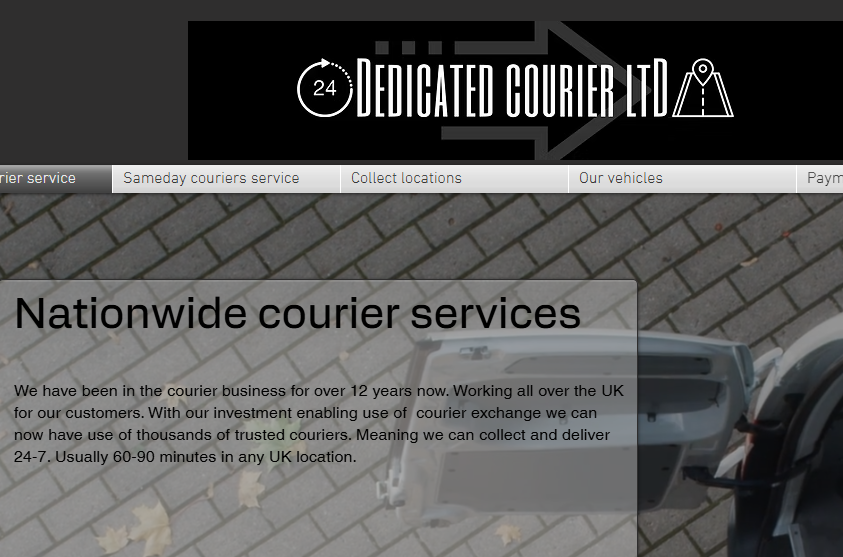
Dedicatedsamedaycourier provides dedicated, exclusive-vehicle courier services across the UK, designed for businesses that cannot afford delivery failures on time-sensitive shipments. Every consignment travels on its own vehicle, which removes the consolidation delays and handling risks that affect shared-load services.
For logistics managers building a multi-carrier strategy, Dedicatedsamedaycourier operates 24 hours a day, seven days a week, with same-day, next-day, and overnight options available nationwide. The service supports urgent collections at short notice and offers a range of van and vehicle options to match load size to route requirements precisely. Whether you need a small van for documents or a larger vehicle for palletised goods, the fleet is matched to the job. Request a quote directly through the website or by phone to integrate dedicated courier capacity into your existing delivery operation.
FAQ
What are the most effective delivery optimisation tips?
Dynamic route planning, proactive customer notifications, and fleet right-sizing are the three highest-impact areas. Together they reduce mileage, improve first-attempt delivery rates, and cut fixed vehicle costs.
How much can dynamic routing reduce delivery mileage?
AI-powered route optimisation reduces delivery mileage by up to 20% by accounting for traffic, vehicle capacity, and delivery windows in real time. Unoptimised fleets lose approximately 10% of mileage to out-of-route driving alone.
How do customer notifications improve delivery success rates?
Proactive notifications with precise two-hour windows improve first-attempt delivery success by 20 to 30 percentage points. They also reduce “Where Is My Order” support tickets by 60 to 80%, lowering customer service costs.
What is the risk of using a single carrier for all shipments?
Concentrating more than 55 to 60% of volume with one carrier exposes operations to capacity disruptions and service failures. A multi-carrier approach with dynamic assignment rules distributes risk and maintains service levels when one carrier underperforms.
How can businesses reduce the cost of returns?
Regional return consolidation hubs operated through 3PL partners cut per-unit return transport costs by 40 to 60%. Blending return pickups into existing outbound routes further reduces the cost by maximising vehicle utilisation on trips that would otherwise run partially empty.
Recommended


Comments