
How to manage returns logistics: reduce cost and recover margin
- Andrew Buttrick
- Aug 8
- 12 min read

Centralise return intake, apply a disposition decision tree, capture SKU-level reason codes, and implement Activity-Based Costing (ABC). That is the operational core of effective returns management. Online return rates in the UK run at roughly 17% across e-commerce categories, and without a structured approach, that volume erodes margin fast. The 5Ps framework from UT GSCI (people, policies, processes, products, partners) gives operations teams a structured model to align decisions across functions. An ERP integration such as NetSuite connects returns tracking, accounting credits and inventory updates in one place.
Start here today:
Schedule a dedicated receiving window, separate from outbound fulfilment, to protect pick-and-pack SLAs.
Enable reason codes at the point of return initiation, not at the warehouse door.
Route high-value items to rapid grading within 24 hours of receipt.
Map every disposition path (resale, refurbish, recycle, donate, return-to-vendor) before the first item arrives.
Pull a baseline cost-per-return figure using your current 3PL invoices and labour logs.
Key takeaways
Effective returns management requires centralised intake, ABC costing, a disposition decision tree and weekly SKU-level reporting to recover margin and reduce avoidable returns.
Point | Details |
Centralise intake first | Dedicated receiving windows and pre-sorted manifests reduce processing time and disputes from day one. |
Replace flat fees with ABC | Assign costs to specific activities (receiving, grading, repack) to reveal true cost-per-return and justify automation. |
Apply the 5Ps framework | Align people, policies, processes, products and partners to avoid cross-functional misalignment that erodes recovery. |
Flag SKUs above 17% return rate | Weekly SKU reason digests with a 17% threshold trigger product or content fixes that suppress avoidable returns. |
Dedicatedsamedaycourier for urgent collections | Same-day dedicated vehicles across the UK provide secure, point-to-point collection for high-value or time-critical returns. |
Table of Contents
Why returns logistics is a strategic business lever
Returns are not a back-office problem. They sit directly on the P&L, affect net promoter scores and carry a growing carbon liability. A poorly run returns operation delays inventory re-entry, inflates carrying costs and pushes customers to competitors after a single bad experience.
Philips reduced reverse logistics costs substantially by centralising grading and applying category-specific disposition rules, demonstrating that operational discipline translates directly into recovered margin. The cautionary counterpoint: Amazon’s partnership with Kohl’s for drop-off returns improved customer convenience scores but created routing complexity that smaller operators cannot replicate without the right network design. Convenience without process control is expensive.
Academic research on returns strategy identifies seven common misalignments across supply chain functions, most of them rooted in returns being treated as a cost to minimise rather than a value stream to manage. The sustainability dimension compounds this: returned goods that reach landfill carry both a direct disposal cost and a growing regulatory exposure under UK packaging waste rules.
Three areas where returns directly hit the numbers:
Margin: unsold returned stock sitting 10–21 days loses resale value daily, particularly in fashion and electronics.
Inventory: delayed re-entry distorts replenishment signals and leads to phantom stockouts.
Carbon: unnecessary transport legs and landfill disposals increase Scope 3 emissions and complicate ESG reporting.
The 5Ps framework: one action per pillar
The 5Ps model structures returns decisions across five dimensions. Applied together, they align cross-functional teams and improve both recovery rate and cost-per-return.
People: train warehouse staff on grading criteria (Grade A–D) and give them authority to route items without supervisor sign-off on standard cases.
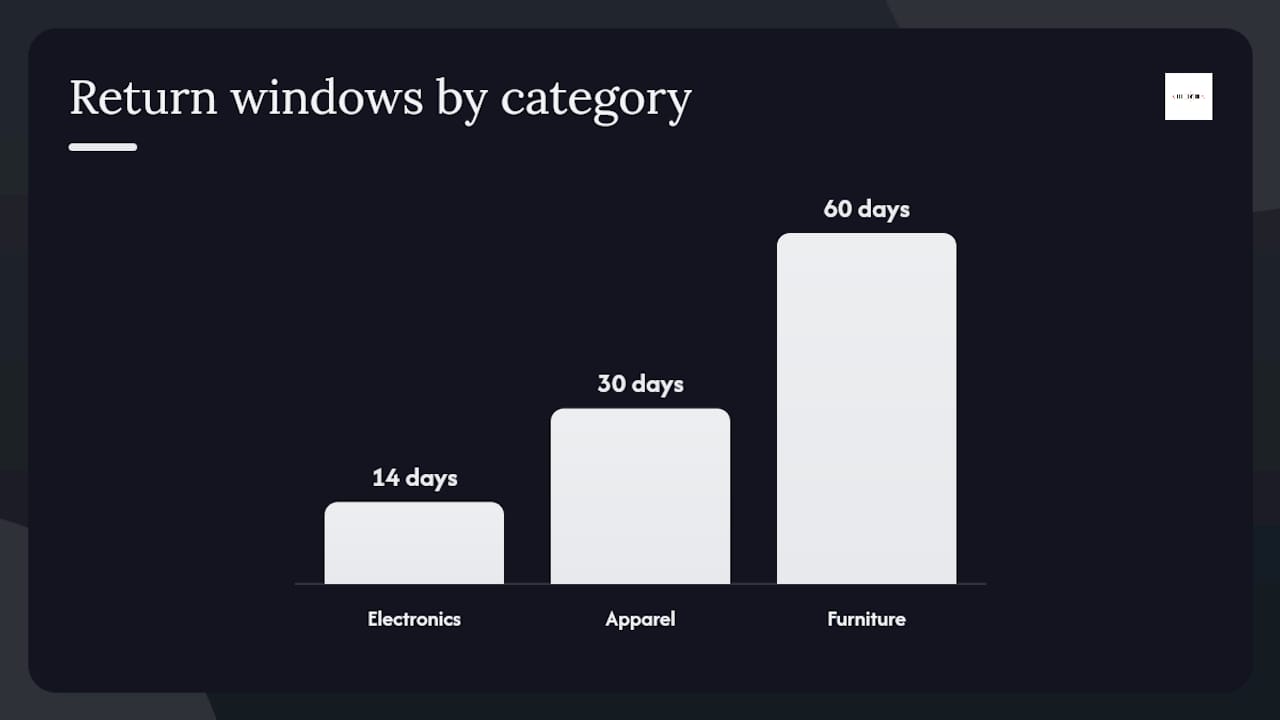
Policies: implement tiered return windows by category (eg. 14 days for electronics, 30 days for apparel) and exchange-first prompts before cash refunds.
Processes: deploy returnless refunds for items where processing cost exceeds resale value; reserve physical returns for high-value or refurbishable goods.
Products: apply category-specific rules. A returned laptop needs testing and data wipe; a returned cushion needs visual inspection only.
Partners: designate a primary returns hub with agreed SLAs for grading turnaround, photo evidence and disposition reporting.
Balance across all five pillars matters. Tightening policies without training people produces grading errors. Investing in partner infrastructure without process rules creates a well-equipped bottleneck.
A 5-step operational roadmap for returns
Audit first, then build. The five steps below move a team from a patchwork system to a structured returns operation.
Audit current state. Map every touchpoint from return initiation to final disposition. Identify where items sit idle, where reason codes are missing and where cost is unattributed.
Define a disposition matrix. Assign each SKU category a primary and secondary disposition path based on item value, condition and demand signal.
Centralise intake and scheduling. Consolidate returns into a dedicated receiving window. Dedicated receiving lanes, pre-sorted inbound manifests and unit-level photography materially reduce processing time and disputes.
Implement a rules engine and WMS integration. Connect disposition codes to your WMS so routing decisions are automated and auditable. NetSuite paired with a WMS provides end-to-end tracking and accounting linkage.
Pilot a KPI dashboard and iterate. Track cost-per-return, days-to-resale and net recovery rate from week one. Adjust disposition rules based on actual recovery data.
Pro Tip: Book your returns receiving window during off-peak hours, typically before 9 AM or after 3 PM, so inbound returns do not compete with outbound pick-and-pack for dock space, staff and scanner capacity.
Item condition | Item value | Primary disposition | Secondary disposition |
As new, sealed | Any | Resale (full price) | Resale (discounted) |
Good, open box | High (>£50) | Refurbish / repack | Resale (discounted) |
Good, open box | Low (<£50) | Resale (discounted) | Donate / liquidate |
Damaged, repairable | High (>£50) | Refurbish | Recycle |
Damaged, unrepairable | Any | Recycle | Return-to-vendor |
How to implement Activity-Based Costing for returns
Flat restocking fees hide the real cost of processing a return. ABC assigns costs to specific activities rather than spreading them as a percentage of sale price, giving finance and operations an accurate view of where money is spent and where automation or outsourcing makes sense.
Map these activities and assign a time and cost driver to each:
Receiving and logging (labour + system time)
Inspection and condition grading (labour + equipment)
Photography and documentation (labour + hardware)
Repackaging (materials + labour)
Testing and data wiping (equipment + labour, category-specific)
Refurbishment (parts + skilled labour)
Outbound shipping for resale or return-to-vendor (carrier cost)
Audits commonly miss hidden line items: 3PL receiving fees of £1.50–£3.00 per unit, inspection labour of £0.75–£2.00 per unit, repackaging materials and carrying costs from returns sitting 10–21 days. Include all of these when modelling cost-per-return.
Present ABC results to commercial teams as a cost-per-activity breakdown rather than a total restocking charge. This makes the case for returnless refunds on low-value items (where processing cost exceeds recovery) and for investing in automation on high-volume activities such as photography and grading.
Technology and partner choices for UK operations
The right stack covers four layers: return initiation, carrier and label logic, grading and disposition automation, and WMS/ERP integration. Ten practical levers for reverse logistics include consistent product templates, fraud detection, routing optimisation and dedicated WMS for returns.
When evaluating platforms and partners, test for:
Customer-facing portal with reason-code capture at initiation
Dynamic carrier selection based on item value, weight and destination
Grading workflows with photo evidence and condition scoring
Disposition routing tied to WMS codes
API maturity for NetSuite or equivalent ERP integration
Regional returns hub coverage across England, Scotland and Wales
For urgent or high-value collections, same-day dedicated courier services are the most reliable option. Dedicatedsamedaycourier operates 24/7 across the UK with dedicated vehicles. This means a returned item travels point-to-point with no co-loading and a clear chain of custody. This matters for electronics, medical devices and any item where condition on arrival at the returns centre affects grading outcome. For retail delivery optimisation that integrates with returns routing, dedicated collection removes the uncertainty of shared carrier networks.
What KPIs should you track for returns performance?
Six metrics cover the full picture:
Net recovery rate: value recovered as a percentage of original sale price, by disposition path.
Cost-per-return (CPR): total processing cost divided by units processed; benchmark against your ABC model.
Days-to-resale: time from return receipt to item back on sale; target under five days for Grade A stock.
Return rate by SKU: weekly, with reason-code breakdown.
Return-suppression rate: percentage reduction in avoidable returns after product or content changes.
Landfill diversion rate: percentage of returned units kept out of landfill through resale, refurbishment, donation or recycling.
Reporting cadence: run a daily disposition snapshot for warehouse managers, a weekly SKU reason digest for merchandising teams, and a monthly P&L recovery report for finance.
Pro Tip: *Build your weekly SKU digest as a BI dashboard filter, not a manual spreadsheet export.
Returns decision tree and disposition rules
A rule-based decision tree routed at point of capture converts returns into recovered value and reduces liquidation losses. Four primary paths cover the majority of cases.
Decision logic at intake:
Is the item unopened and undamaged? Route to resale at full or near-full price.
Is the item open but functional and above £50 in value? Route to refurbishment or repack for discounted resale.
Is the item damaged but repairable and above £50? Route to refurbishment queue.
Is the item below £50 and damaged, or processing cost exceeds recovery value? Route to recycle, donate or liquidate.
Grading checklist for frontline staff:
Grade A: sealed, original packaging, no visible use. Resale at full price.
Grade B: open box, no damage, all accessories present. Resale at 10–20% discount or refurbish.
Grade C: functional, minor cosmetic damage, accessories may be missing. Refurbish or discounted resale.
Grade D: non-functional or significant damage. Recycle, parts salvage or return-to-vendor.
Implement these grades as disposition codes in your WMS. Returns decision matrices encoded as WMS disposition codes remove human discretion and create an auditable trail for recovery metrics.
Policy levers and customer experience trade-offs
Five levers shape both customer behaviour and unit economics: monetary (refund vs. store credit), time (return window length), effort (drop-off vs. home pickup), scope (what is eligible), and exchange (exchange-first vs. refund-first).
Recommended guardrails for UK operators:
Offer exchange-first prompts before cash refunds; this retains revenue and reduces net return volume.
Provide free drop-off for items under £30 in value; reserve home pickup for orders above £75 or for loyalty tier customers.
Cap free returns at three per customer per quarter for accounts showing high return frequency.
Apply category-specific windows: 14 days for electronics, 30 days for apparel, 60 days for furniture.
For B2B accounts, negotiate contractual return terms rather than applying consumer policy defaults.
UK operators must also account for the Packaging Waste Regulations when disposing of return packaging, and must handle any personal data captured during the returns process in line with UK GDPR. A clear return policy page, such as the example from Alien Ramp, shows how monetary, time and scope levers can be presented transparently to customers without creating ambiguity.
Inbound Logistics’ ten optimisation tips include save-the-sale tactics and fraud detection as policy-level levers that reduce net return volume without degrading CX.
30/60/90-day implementation checklist
Phase | Priority tasks | Cost drivers |
Days 0–30 | Audit current returns flow; map all disposition paths; baseline CPR from 3PL invoices; enable reason codes at initiation | Labour (audit), system access fees |
— | Build disposition matrix; pilot ABC on one SKU category; test WMS/NetSuite integration; negotiate partner SLAs | Integration development, photography equipment, repack materials |
— | Launch KPI dashboard; run weekly SKU digest; expand ABC to full catalogue; review and adjust disposition rules | Carrier costs, ongoing labour, BI tooling licence |
Assign a returns programme owner with cross-functional authority over warehouse, merchandising and finance.
Run the audit before committing to any technology purchase; the audit defines requirements.
Pilot ABC on a single high-volume SKU category before rolling out to the full catalogue.
Test NetSuite or WMS integration in a sandbox environment before go-live.
Review partner SLAs at day 60 against actual grading turnaround and photo evidence compliance.
Insurance and risk management for returns in transit
Goods in transit insurance is the baseline requirement for any return moving via a third-party carrier. Standard parcel carrier liability in the UK is typically capped at a low per-kilogram rate, which falls well short of the actual value of electronics, medical devices or high-end apparel. Operators should verify that their carrier holds adequate hire and reward insurance and that the policy covers the full declared value of goods being returned.
For high-value returns, a dedicated vehicle with a named driver and a signed proof of collection provides a stronger chain of custody than a shared parcel network. Photograph items before dispatch and retain the images alongside the carrier’s collection receipt. This documentation is the primary evidence in any damage or loss dispute. Where items carry data (laptops, tablets, phones), a documented data-wipe protocol at the returns centre is both a risk management requirement and a UK GDPR obligation.

UK reverse logistics network design
Depot location decisions for a UK returns network should account for population density, carrier hub proximity and cross-border complexity. A central England location (Midlands corridor) typically offers the shortest average transit time to and from the majority of UK postcodes. Secondary hubs in Scotland and the South-East reduce days-to-resale for high-volume regions.
Post-Brexit, any returns involving goods originally imported from the EU require attention to customs documentation. A returned item sent back to a European supplier may need an export declaration, and re-importing refurbished stock from the EU carries import duty implications. HMRC’s Returned Goods Relief can reduce or eliminate duty on items re-imported within three years, but the relief requires documentary evidence of original export. Operators running cross-border returns should confirm their customs broker’s capability to handle this before designing the network. For delivery options that integrate with depot routing, dedicated courier services offer flexible vehicle sizing and point-to-point routing between returns hubs.
Environmental sustainability in returns beyond landfill diversion
Landfill diversion rate is a starting point, not a sustainability strategy. UK operators with ESG commitments need to report on carbon per return (transport emissions), material circularity (percentage of returned goods re-entering the supply chain as product rather than parts or waste), and packaging reuse rates.
Practical steps beyond diversion:
Measure transport emissions per return leg using carrier-provided carbon data or a tool such as the UK Government’s conversion factors for greenhouse gas reporting.
Track the percentage of returned items resold, refurbished or donated versus downcycled or scrapped.
Reuse return packaging where condition allows; this reduces both materials cost and Scope 3 emissions.
Report circularity metrics alongside financial recovery metrics in the monthly P&L report so sustainability and margin recovery are evaluated together.
The ABC costing model supports this directly: when the cost of each disposition activity is visible, teams can identify where refurbishment is cheaper than recycling and where packaging reuse saves more than it costs to process.
Customer communication throughout the returns process
Clear, timely communication reduces inbound enquiries, builds trust and increases the likelihood of a repeat purchase after a return. The key moments to communicate are: return initiation confirmation, collection or drop-off confirmation, item receipt at the returns centre, grading outcome, and refund or exchange processing.
Automate the first four touchpoints via your returns management platform. The grading outcome notification is the one most operators skip, and it is the one that most directly affects customer confidence. A customer who knows their item has been received and assessed is far less likely to raise a dispute or a chargeback.
For delivery options that set customer expectations clearly, the communication model for outbound deliveries applies equally to returns: proactive status updates at each stage remove uncertainty. Keep message content factual: confirmation number, item description, next step, and expected timeline. Avoid vague language such as “we are processing your return” with no timeframe attached.
The part of returns logistics most operators underestimate
The operational mechanics of returns management are well documented. The harder problem is organisational: returns sit across warehouse, finance, merchandising and customer service, and no single team owns the full P&L impact. The ASCM reverse logistics framework recommends centralised return centres precisely because fragmented ownership produces fragmented data.
The weekly SKU reason digest is the most underused tool in the returns manager’s kit. Most teams collect reason codes but route them only to the warehouse. When those codes reach merchandising and product teams weekly, avoidable returns drop because the root cause (wrong size guide, misleading product image, quality defect) gets fixed at source rather than processed indefinitely at cost. That feedback loop is where returns management shifts from cost control to margin recovery.
Urgent returns collections via dedicated same-day courier
When a return cannot wait for a scheduled carrier collection, a dedicated same-day vehicle is the most reliable option for protecting item condition and chain of custody.
[
Dedicatedsamedaycourier provides same-day collection across the UK, 24 hours a day, with dedicated vehicles that carry one consignment at a time. No co-loading, no shared network delays. This is particularly relevant for high-value electronics, B2B urgent returns and any item where condition on arrival at the returns centre determines grading outcome. For time-critical collections, book a same-day courier or request a quote via phone or online form. Vehicle options from small vans to larger capacity are available; see the full courier vehicle range to match the right vehicle to your return volume.
Further reading and primary sources
Use these sources for internal briefings, vendor RFPs and executive presentations:
5Ps of returns management white paper, UT GSCI — primary framework reference.
Optimising reverse logistics costs, Supply Chain Management Review — ABC methodology and sustainability alignment.
How to build a reverse logistics system that cuts return costs, Ecommerce Times — operational tactics: receiving lanes, manifests, photography.
How to build a reverse logistics programme that recovers real margin, Ecommerce Times — SKU reporting, disposition matrix, hidden cost line items.
Reverse logistics primer, ASCM — stages and centralisation recommendations.
10 tips for optimising reverse logistics, Inbound Logistics — ten practical levers including fraud detection and reCommerce.
Returns as a revenue engine, SupplyChainDive — decision tree and point-of-capture routing.
Reverse logistics and returns management, NetSuite — ERP/WMS integration guidance.
Returns management strategy research, ScienceDirect — academic framework identifying seven strategic misalignments.
Sources
Recommended


Comments