
What is time-sensitive delivery? A clear guide
- Andrew Buttrick
- Jun 13
- 7 min read

TL;DR:
Time-sensitive delivery guarantees goods arrive within a fixed, critical window, with delays incurring significant operational costs.
It employs dedicated transport modes, rapid activation, and real-time tracking to ensure punctuality across industries like aerospace, healthcare, and retail.
Time-sensitive delivery is defined as the transportation of goods that must arrive within a strict, fixed timeframe where delays carry significant operational or financial consequences. The industry term for this is time-critical transport, and it sits above standard express or expedited shipping in terms of precision and accountability. Sectors including aerospace, healthcare, and retail depend on it daily. An Airbus AOG event, for example, can cost over EUR 120,000 per day when a grounded aircraft waits for a critical part. That figure alone explains why time-sensitive shipping is treated as a non-negotiable operational requirement rather than a premium add-on.
What is time-sensitive delivery and how does it work?
Time-sensitive delivery guarantees cargo arrives within a specific, agreed window rather than offering a broader delivery range. This is the core distinction from general express services. The delivery window can be defined down to the hour or, in critical aerospace and pharmaceutical cases, down to the minute.

Operationally, time-critical transport replaces the standard hub-and-spoke network with dedicated transport modes running 24 hours a day, seven days a week. Goods travel on a single, exclusive vehicle from collection point to destination without consolidation stops or shared loads. This removes the primary cause of delays in conventional freight: transfers between hubs.
Industries that rely on this model include aerospace MRO (maintenance, repair, and overhaul), NHS surgical supply chains, pharmaceutical cold chains, and time-critical retail replenishment ahead of promotional events. Each of these sectors treats a missed delivery window not as an inconvenience but as a direct operational failure.
How do logistics providers execute time-critical transport?
The transport modes used in time-sensitive shipping vary by urgency, distance, and cargo type. The table below summarises the most common options:
Transport mode | Typical use case | Response capability |
Sprinter van or car | Urban and regional urgent parcels | Immediate, within the hour |
Hot shot truck | Oversized or heavy critical freight | Same day, dedicated route |
Onboard courier (OBC) | International critical parts or documents | Next available commercial flight |
Dedicated HGV | Palletised urgent freight, nationwide | Scheduled same day or overnight |
Rapid activation is a defining feature of this service category. In aerospace and pharmaceutical logistics, courier assignment within 15 minutes of order placement is the accepted standard. That speed of mobilisation is only possible when a provider operates a live network of available drivers rather than relying on batch scheduling.
Real-time tracking and direct communication throughout the journey are equally critical. Continuous client updates allow operations teams to coordinate receiving staff, prepare equipment, or adjust downstream processes based on confirmed delivery progress. Without this visibility, the guaranteed window loses its practical value.
Pro Tip: When booking a time-critical delivery, confirm that the provider offers direct driver contact, not just a tracking portal. In genuine emergencies, speaking to the driver directly can resolve access or routing issues in seconds.
How does time-sensitive delivery differ from expedited shipping?
Expedited shipping and time-sensitive delivery are often used interchangeably, but they describe different service levels. Understanding the difference matters when selecting the right option for urgent cargo.
Key differences include:
Delivery window precision. Expedited shipping offers a faster general service, typically next day or two day. Time-sensitive delivery commits to a specific window, such as delivery by 10:00 on a named date.
Cargo exclusivity. Time-sensitive shipments travel on dedicated vehicles with no shared loads. Expedited freight often still moves through shared networks, just prioritised within them.
Handling and security. Time-critical services include specialised handling such as lift gate access, two-man teams, and enhanced monitoring for high-value or fragile goods. Standard expedited services rarely offer this by default.
Cost structure. Time-sensitive delivery carries a premium that reflects the dedicated resource, rapid mobilisation, and guaranteed outcome. Expedited shipping is cheaper but offers no window-level guarantee.
Same day delivery meaning. Same-day delivery is one subset of time-sensitive delivery, covering collections and deliveries completed within the same calendar day. Not all time-sensitive shipments are same day, but all same-day deliveries are time-sensitive by definition.
The practical rule: if a missed delivery has a measurable financial or operational consequence, time-sensitive delivery is the correct service. If speed is preferred but not critical, expedited shipping is sufficient.
Examples of time-sensitive shipments and their business impact
Real-world examples of time-sensitive deliveries illustrate why the stakes are high across multiple sectors.
Industry | Shipment type | Consequence of delay |
Aerospace | AOG aircraft parts | Over EUR 120,000 per day in grounding costs |
Healthcare | Surgical supplies and implants | Cancelled operations, patient harm risk |
Retail | Promotional stock ahead of launch events | Lost sales, reputational damage |
Pharmaceutical | Temperature-controlled medicines | Product loss, regulatory breach |
The healthcare sector provides some of the most demanding examples of time-sensitive shipments. A documented winter storm case saw a medical courier plan and execute a critical delivery of surgical supplies before worsening conditions closed routes. The planning required minute-level scheduling and real-time weather monitoring. A standard courier service would not have had the operational flexibility to respond.
Aerospace AOG missions are equally instructive. When an Airbus A320 flap was required in Athens from Hamburg, MBS Logistics completed the delivery in seven hours. That outcome required immediate driver assignment, airport coordination, and customs pre-clearance running in parallel, not sequentially.
Pro Tip: For healthcare and pharmaceutical shipments, always confirm that the courier holds goods-in-transit insurance covering the full declared value of the cargo. Standard hire and reward insurance may not cover specialist medical equipment.
How to plan and manage time-sensitive delivery needs
Businesses and individuals can reduce risk and cost by approaching time-sensitive logistics systematically rather than reactively.
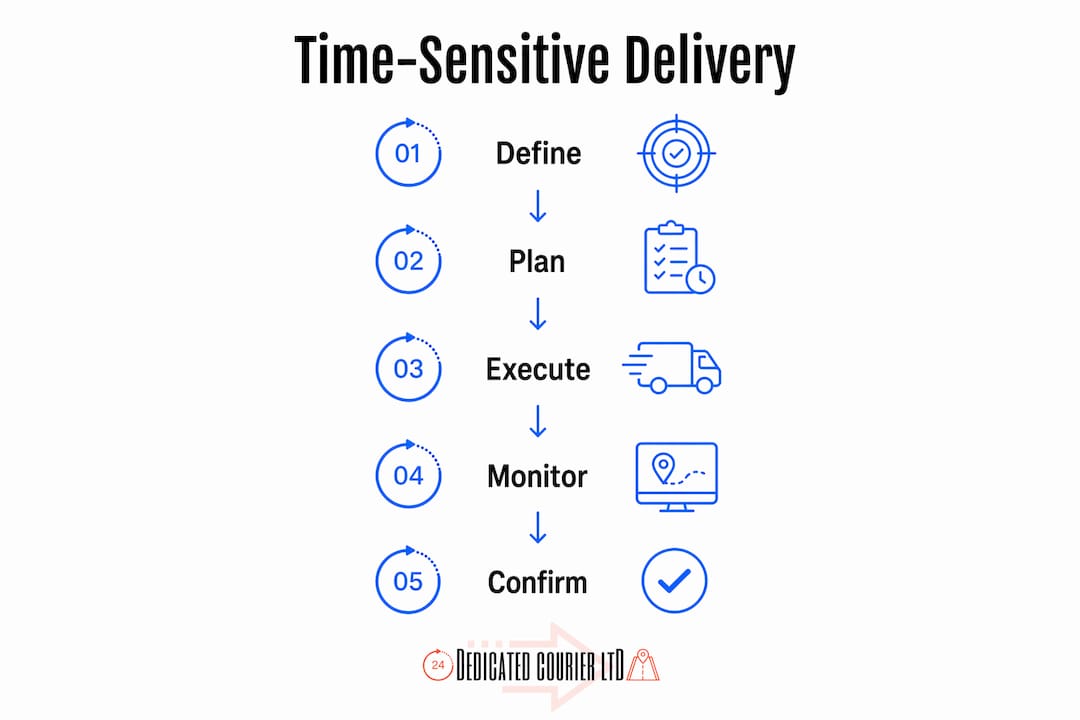
Define the delivery window precisely. Identify the latest acceptable arrival time and work backwards to set the collection time. Vague instructions like “as soon as possible” create ambiguity that delays action.
Choose a dedicated courier partner. A provider operating 24/7 urgent logistics with a live driver network can mobilise faster than one relying on scheduled runs.
Use real-time tracking. Confirm the provider offers live GPS tracking and direct driver contact, not just estimated time of arrival notifications.
Build contingency into the plan. Weather and route disruptions require providers to adjust in real time. Ask your courier how they handle route closures before you book, not during the delivery.
Document cargo requirements in advance. Specialist handling needs such as temperature control, two-man lifts, or tail-lift access must be communicated at the point of booking. Last-minute requests delay departure.
Following a structured courier process from the outset reduces the likelihood of errors that compound under time pressure.
Key takeaways
Time-sensitive delivery requires dedicated transport, rapid mobilisation, and a guaranteed delivery window to prevent operational failures across aerospace, healthcare, and retail.
Point | Details |
Definition | Time-sensitive delivery guarantees arrival within a strict, fixed window with measurable consequences for failure. |
Transport modes | Dedicated vehicles including sprinter vans, hot shot trucks, and onboard couriers replace shared hub networks. |
Difference from expedited shipping | Time-sensitive delivery commits to a specific window and exclusive vehicle; expedited shipping offers speed without that guarantee. |
Real-world stakes | Aerospace AOG delays cost over EUR 120,000 per day; healthcare delays can result in cancelled operations. |
Planning best practice | Define the window precisely, confirm 24/7 provider availability, and communicate handling requirements at booking. |
Speed and precision are now the baseline, not the exception
The importance of timely delivery has shifted significantly in the past five years. What was once treated as a specialist service for aerospace and pharmaceutical clients is now a standard expectation across retail, manufacturing, and professional services. Businesses that previously accepted next-day delivery as adequate are now building same-day and time-critical options into their standard operating procedures.
What I find most telling is how the cost of failure has become more visible. When a surgical procedure is delayed or a production line stops, the financial and reputational damage is now tracked and reported in a way it simply was not a decade ago. That visibility has forced logistics buyers to treat time-sensitive delivery as a risk management tool, not just a fast delivery option.
Technology has made the service more reliable and more accessible. Live tracking, instant driver assignment, and digital proof of delivery have removed much of the uncertainty that once made urgent logistics feel unreliable. The providers who invest in these capabilities consistently outperform those who treat urgent delivery as a reactive, ad hoc service.
— andrew
How Dedicatedsamedaycourier handles time-critical shipments
Dedicatedsamedaycourier operates a nationwide network of dedicated courier vehicles available 24 hours a day, seven days a week, covering urgent same-day, next-day, and overnight deliveries across the UK.
[

Every shipment travels on an exclusive vehicle, meaning no shared loads and no consolidation delays. The service covers everything from documents and parcels to pallets, with vehicle options matched to the size and handling requirements of each consignment. For businesses managing urgent same-day requirements, Dedicatedsamedaycourier provides tailored quotes by phone, email, or online form, with rapid driver assignment and real-time tracking from collection to delivery.
FAQ
What is time-sensitive delivery in logistics?
Time-sensitive delivery is the transport of goods that must arrive within a guaranteed, fixed timeframe where delays carry direct operational or financial consequences. It is also referred to as time-critical transport and sits above standard express or expedited services in terms of precision.
What are examples of time-sensitive shipments?
Common examples include aerospace AOG parts, surgical supplies for scheduled operations, pharmaceutical cold-chain medicines, and retail stock ahead of promotional launches. Each carries a measurable cost if the delivery window is missed.
How does time-sensitive delivery differ from expedited shipping?
Expedited shipping offers faster general transit times but does not guarantee a specific delivery window. Time-sensitive delivery commits to a precise arrival time on a dedicated vehicle with no shared loads.
What does same-day delivery mean in a time-sensitive context?
Same-day delivery means collection and delivery are completed within the same calendar day. It is one category of time-sensitive delivery, typically used for urgent local or regional shipments where next-day arrival is not acceptable.
How quickly can a time-sensitive courier be arranged?
In aerospace and pharmaceutical logistics, courier assignment within 15 minutes of order placement is the accepted operational standard. Providers operating live driver networks can mobilise significantly faster than those using scheduled batch systems.
Recommended


Comments