
Secure document delivery: a step-by-step workflow guide
Updated: May 6

TL;DR:
Failed document deliveries can lead to missed deadlines, legal penalties, and reputational damage for businesses and legal professionals.
Proper risk assessment, secure handling, real-time tracking, proof of delivery, and trusted courier partnerships are essential to ensure compliance and protect sensitive materials.
A failed document delivery is not just an inconvenience. For businesses and legal professionals, it can mean a missed court deadline, a lost contract, or a breach of compliance obligations. The consequences range from financial penalties to serious reputational damage. Getting sensitive materials from A to B on time and with a verifiable record requires more than booking a courier and hoping for the best. This guide walks through every stage of the process, from identifying risks to archiving proof of delivery, so your workflow is consistent and your deliveries are defensible.
Table of Contents
Key Takeaways
Point | Details |
Plan for compliance | Always align delivery methods with regulatory and legal requirements to avoid risk. |
Track and document | Use tracked services and keep proof of delivery for every urgent or sensitive item. |
Act fast on issues | Immediate follow-up and robust contingency planning minimise costly errors. |
Choose the right partner | A trusted, high-performance courier is the backbone of any reliable document delivery workflow. |
Understanding document delivery risks and requirements
Before you arrange any delivery, it pays to understand exactly what can go wrong and why certain documents demand more than a standard postal service.
Missed deadlines are the most obvious risk. Legal documents served even one day late can result in a claim being struck out or a limitation period expiring. Commercial documents such as signed contracts, tender submissions, or financial instruments carry similar time pressures. The cost of a failed delivery is rarely just the courier fee.
Security is the other major concern. Sensitive materials, whether personal data, identity documents, or confidential business correspondence, require controlled handling throughout transit. A breach during delivery can trigger data protection liability under UK GDPR, not just embarrassment.
Knowing what the secure delivery explained process actually involves helps you match the right service to the right document. Key requirements include:
Live tracking so you can monitor progress in real time
Signature on delivery to create a verifiable proof of delivery record
Redelivery or depot fallback for when the recipient is unavailable
Dedicated handling for items that cannot be grouped with unrelated packages
For government materials such as passports and exam scripts, UK government guidance specifies tracked Royal Mail or Parcelforce services with mandatory signature requirements, redelivery options, and depot fallback arrangements. Third-party couriers are used only in exceptional circumstances.
For legal proceedings, the stakes are even higher. Under CPR Part 6, personal service remains the gold standard for claims and injunctions. Postal service is deemed to occur on the second business day after posting, but failures in this process risk a claim being struck out entirely. Always retain proof of delivery, no exceptions.
Key point: The appropriate delivery method depends on the document’s legal sensitivity. Treating every document as if it were routine is one of the most common and costly mistakes.
Review urgent delivery best practices to align your internal standards with what serious document handling actually requires.
What you need before arranging delivery
With your requirements and risks identified, it is time to gather what you will need to avoid costly or embarrassing mistakes.
A clear pre-delivery checklist removes the guesswork and ensures nothing is overlooked at the point of booking.
Essential information to confirm before booking:
Full sender and recipient addresses, including postcodes and floor or unit numbers
Direct contact numbers for both parties
Hard deadline for delivery, including any legal service windows
Document type and its specific handling or confidentiality requirements
Chosen proof of delivery method: signature, electronic confirmation, or timestamped photograph
Physical preparation:
Secure packaging appropriate to the document type (sealed envelopes, tamper-evident pouches)
Clear labelling with recipient name, address, and any “confidential” markings
Written instructions inside the package if the courier needs to follow a specific handover procedure
Verifying courier suitability:
Requirement | What to check |
Insurance | Goods in transit cover and hire and reward insurance |
Tracking capability | Real-time GPS tracking, not just scanning milestones |
Signature on delivery | Mandatory, not optional |
Handling for sensitive items | Dedicated vehicle, not shared load |
Contingency process | Redelivery policy and depot arrangements |
For government and regulated documents, caseworker guidance is explicit that signature and tracking are non-negotiable. Apply the same standard regardless of whether you are in the public or private sector.
Pro Tip: Always confirm that your chosen courier can produce a timestamped electronic signature record. A paper log that cannot be retrieved digitally offers limited protection in a dispute.
Use the best practices checklist to cross-reference your preparation against recognised industry standards before you book.
Step-by-step document delivery workflow
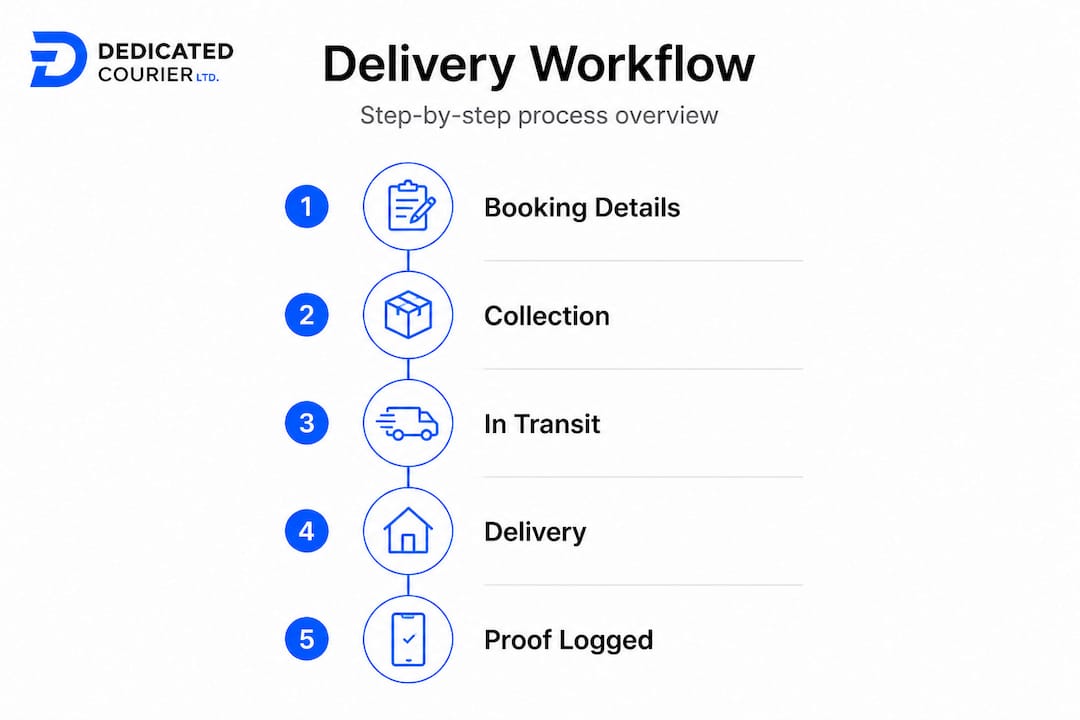
Now you have all prerequisites, here is the delivery process broken down into clear, actionable steps you can follow every time.
Prepare the document and packaging. Use tamper-evident materials. Label clearly. Include a handling note if required.
Book the courier with full job details. Provide recipient contact number, delivery address, deadline, and any access instructions upfront.
Confirm collection window. For same-day services, industry benchmarks show collection under 60 minutes from booking confirmation, with on-time delivery targets of 96 to 98 per cent.
Hand over the document to the courier. Confirm the courier’s identity. Obtain a collection receipt or booking reference.
Monitor live tracking. Do not wait for a delivery notification. Check progress actively, especially for legally time-bound materials.
Confirm delivery and obtain POD. Electronic signature and timestamp should be received within minutes of delivery.
Archive the POD immediately. File it against the relevant matter, contract, or case reference.
Comparison of delivery methods:
Feature | Same-day dedicated courier | Next-day tracked post |
Collection speed | Under 60 minutes | Next morning at earliest |
Live tracking | Yes, GPS real-time | Scan milestones only |
Signature on delivery | Standard | Optional surcharge |
Dedicated vehicle | Yes | No, shared load |
On-time reliability | 96 to 98 per cent | Industry average around 86 per cent |
Legal service suitability | High | Variable |
The step-by-step delivery guide covers this process in further detail, including how to handle bookings for multiple locations.
Pro Tip: When urgency is critical, use a dedicated service rather than a grouped courier run. Sharing a vehicle with unrelated packages introduces delays that are outside your control. Review same day courier options to compare what is available for your route.
Troubleshooting: common failures and how to avoid them
Even with the best workflow, snags happen. Here is how to spot issues early and ensure full compliance.
The most frequent points of failure are straightforward but often preventable:
Wrong or incomplete address. A missing flat number or incorrect postcode is the single most avoidable cause of failed first attempts.
Recipient unavailable. No prior notification sent to the recipient means no one is there to sign.
Missing proof of delivery. The courier completes the job but no POD is retrieved or filed.
Lost or damaged document in transit. Usually a result of inadequate packaging or using an uninsured service.
Legal service deadline missed. Using postal service without accounting for the deemed service rule under CPR Part 6 can invalidate service entirely.
For legal deliveries in particular, failures are not just logistical problems. A missed service deadline can result in a claim being struck out or a limitation period expiring, both of which carry serious consequences.
Warning: Retaining POD is not optional for legal matters. Court procedure rules require proof via statement or affidavit in personal service situations. If you cannot produce it, the service may be treated as invalid.
Immediate follow-up is essential when a delivery fails. Contact the courier within the hour, confirm any redelivery arrangements, and notify the recipient directly. Do not wait for an automated update.
Record keeping matters beyond individual deliveries too. Retain all tracking logs, correspondence with the courier, and POD records for a minimum of six years for commercial documents or longer for legal matters. Reviewing choosing a delivery method can help you avoid selecting services that lack the contingency options needed for high-stakes materials.

Verifying and documenting delivery success
Having sent your item, confirming and recording its safe arrival is just as important as the dispatch itself.
A delivery confirmation is not just a courtesy notification. It is a formal record that protects your business in the event of a dispute, a compliance audit, or a legal challenge.
Key steps for verifying and archiving delivery:
Retrieve the electronic signature. This should include the recipient’s name, time, and date.
Download and save the tracking log. The full route history, including geotags and scan milestones, provides corroborating evidence.
File against the relevant reference. Match POD records to the job, matter number, or contract immediately, not retrospectively.
Confirm receipt with the recipient. A brief email confirmation from the other party adds a second layer of evidence.
Under CPR Part 6, court documents require proof by statement or affidavit in personal service cases. Even for non-legal deliveries, a timestamped digital POD is the most reliable protection against a “never received” dispute. Review tracking and documentation standards to ensure your archiving process meets the level required for your sector.
Statistic callout: UK courier data shows that 14 per cent of next-day deliveries fail on the first attempt. Without proper documentation, you have no immediate record of whether that failure was yours or the courier’s.
Our take: workflow shortcuts and what matters most
The workflow described above covers the process properly. But in practice, the businesses that avoid serious delivery failures are not always those with the most elaborate procedures. They are the ones who have locked in a small number of reliable habits.
Checking recipient details before every single booking prevents the majority of failed deliveries. It sounds obvious but it is the step most often skipped under time pressure. An incorrect postcode or a missing contact number costs far more in recovery time than the 30 seconds of verification would have taken.
Loyalty to a trusted courier matters more than most businesses realise. Switching provider to save a few pounds on an urgent legal or contractual delivery is a false economy. Compliance-grade services require couriers who understand the stakes, carry adequate insurance, and can produce documentation quickly when challenged.
The legal dimension is where even experienced professionals sometimes fall short. Post-service via standard mail is routinely used for documents where personal service is actually required. The expert delivery tips we recommend are built around avoiding exactly this kind of costly oversight.
What feels like overkill, obtaining a second form of confirmation, archiving every tracking log, briefing the recipient before dispatch, is rarely overkill when the alternative is a claim struck out or a contract disputed.
Secure your documents with dedicated courier services
Reliable document delivery starts with the right operational partner, one who understands urgency, handles sensitive materials correctly, and provides the documentation your business needs to stay protected.
[
DedicatedSameDayCourier.co.uk operates 24/7 across the UK, offering dedicated same-day, next-day, and overnight services with real-time tracking and signature on delivery as standard. Every booking uses an exclusive vehicle, so your documents travel alone, not alongside unrelated packages. From legal filings to confidential contracts, the dedicated sameday courier service is built around the standards this guide describes. Explore available van courier options for different document volumes, or visit the dedicated courier network to request a quote for your next urgent delivery.
Frequently asked questions
What is proof of delivery (POD) and why is it important?
Proof of delivery is a signed or otherwise verifiable record confirming successful receipt, and it is essential for legal and compliance purposes. Under CPR Part 6, failing to retain POD for court documents can result in service being treated as invalid.
Which courier method is best for high-security or urgent documents in the UK?
Tracked same-day or next-day courier services with mandatory signature and live GPS tracking are the most reliable option. Government guidance requires signature and tracked services for secure documents including passports and exam scripts.
What happens if a document is not delivered on the first attempt?
Most tracked services offer redelivery or depot collection, but repeated failure carries real consequences for legal and time-bound materials. Government caseworker guidance specifies that fallback to depots with redelivery options must be in place for sensitive documents.
Does using a courier satisfy legal service requirements for court documents?
Not always. CPR Part 6 rules specify that personal service is required for certain claims and injunctions, and postal or courier delivery does not automatically satisfy this requirement.
How quickly should I expect same-day document collection?
UK industry benchmarks show same-day collection within 60 minutes of booking confirmation, with on-time delivery targets between 96 and 98 per cent for dedicated services.
Recommended


Comments