
Fast delivery strategies 2026: a profitable speed playbook
Updated: Aug 30
The fast delivery strategies working in 2026 come down to five moves: segment your delivery promises by demand density, cut seconds off every stop, build a hybrid network instead of relying on one carrier, invest technology budget only where it proves its return, and measure everything with proper incrementality testing rather than guesswork. That is the whole playbook. The detail is where most operators get it wrong.
Speed on its own is not the goal. Profitable speed is. A same-day promise that costs more than it earns in repeat custom is a liability, not a service level. Supply Chain Management Review frames this as delivery promise engineering — treating faster delivery as a network design decision built on demand density, inventory proximity, transport reach, and cost to serve.
Segment delivery promises by postcode-level demand density, not gut feel
Cut stop time through pre-notification, gate codes, and digital proof of delivery
Build a hybrid network across owned and partner capacity for resilience
Spend on routing and forecasting tech only where the pilot data justifies it
Measure cost per delivery, on-time rate, and repurchase lift before scaling any promise
The courier services market is worth several hundred billion dollars and growing at roughly 7 to 8% a year, pulled along by same-day and next-day demand. If you have spare capital, invest it in measurement and stop-level efficiency before you invest it in a bigger fleet.
If you are a small operator with limited capital, start with the quick wins further down this guide. If you run volume through dense urban postcodes, the network and technology sections matter more. Either way, a dedicated courier partner such as Dedicatedsamedaycourier gives you a fast way to test a faster promise before committing to permanent infrastructure.
Key Takeaways
Profitable speed, not maximum speed, wins in 2026: it requires demand-density segmentation, stop-level efficiency, hybrid networks, targeted technology, and rigorous measurement to succeed.
Point | Details |
Segment by demand density | Map orders per postcode and only promise same-day or next-day where density supports the margin. |
Fix stop time first | Pre-notification, gate codes, and digital proof of delivery can cut a 3 to 5 minute stop to 60 to 90 seconds. |
Build a hybrid network | Combine owned capacity for dense core volume with partners for overflow, reach, and resilience. |
Spend on routing before forecasting | Dynamic route optimisation typically returns 15 to 30% in delivery cost savings, the fastest payback of any tech investment. |
Test before you scale | Run incrementality tests comparing faster and standard promises on repurchase lift, not just delivery speed. |
Use dedicated capacity to pilot | Dedicatedsamedaycourier’s same-day and next-day vehicles let you test a faster promise in one postcode before committing to permanent infrastructure. |
Table of Contents
What does profitable speed mean for fast delivery strategies in 2026?
Profitable speed means matching the delivery promise to what the market can actually support financially, not to what sounds impressive on a product page. A same-day promise across a sparse rural postcode almost always loses money. The same promise in a dense city postcode, with enough parcel volume per mile driven, usually pays for itself.
Demand density is the number that decides this. Track orders per postcode, stops achievable per driver hour, and average parcel value by area. When density is high, a driver can complete more drops per hour, and cost per delivery falls even as speed rises. When density is low, faster promises mean empty miles and idle time, which is where margin disappears.
Decentralising inventory closer to customers speeds up fulfilment, but it comes at a price: higher safety stock, more warehouse rent, and working capital tied up in stock sitting nearer the edge of your network. That tradeoff needs to be run as a calculation, not an assumption.
Pull twelve months of order data and map density by postcode sector
Rank postcodes by orders-per-mile-driven, not just total order count
Pilot next-day or same-day promises only in your top-density tiers first
Run a four-to-six-week test before rolling any promise out nationally
Emarketer’s last-mile delivery analysis puts last-mile costs at around 53% of total shipping spend, which is exactly why getting this segmentation right matters more than chasing speed everywhere at once.
How much time can better stop efficiency actually save?
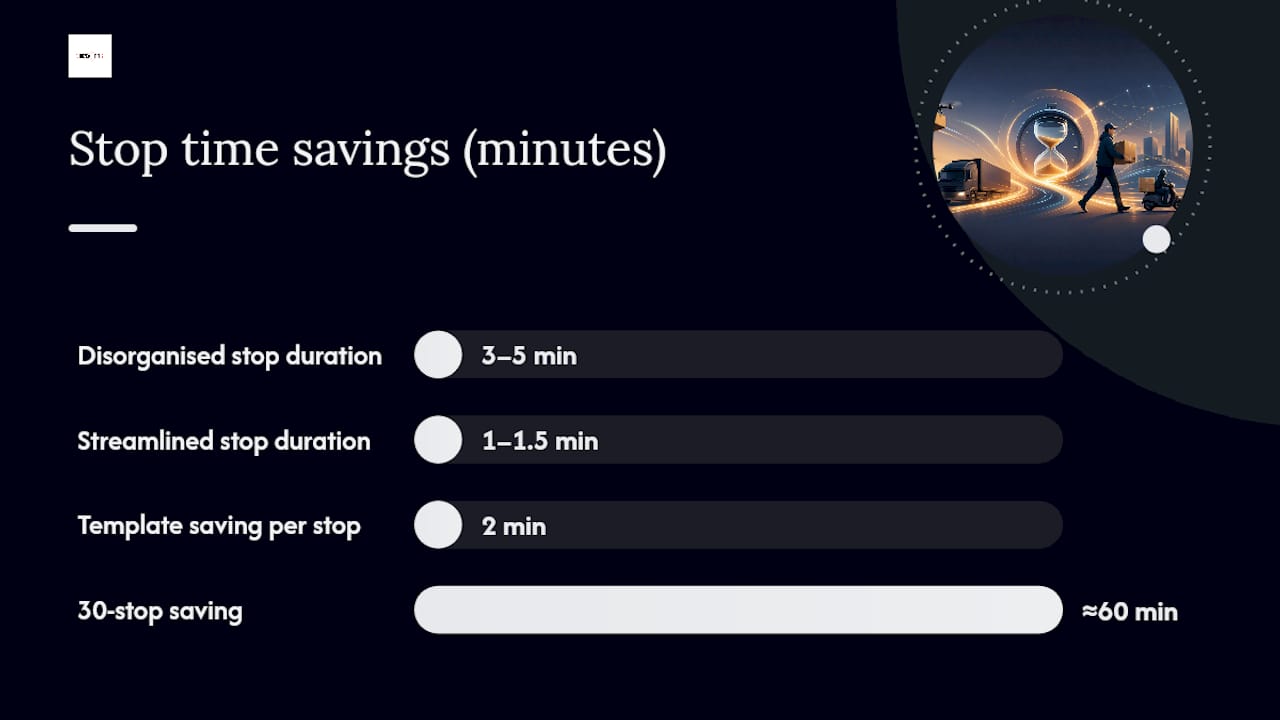
A disorganised stop takes 3 to 5 minutes. A streamlined one, with instructions known in advance and proof of delivery captured digitally, takes 60 to 90 seconds. Across 30 stops in a shift, that difference recovers roughly an hour of driver time, according to Salesforce’s WISMO research — time you can put towards extra drops rather than idling at a gate.
Most of that saving comes from a handful of fixable habits:
Pre-notify customers with a tight ETA window before the driver arrives
Capture gate codes, buzzer numbers, and access instructions at order entry, not on arrival
Pre-label and pack the vehicle in delivery-route order the night before
Standardise proof of delivery on a single driver app rather than mixed paper and phone photos
None of this works without the right systems underneath it. A driver app that captures delivery instructions and proof of delivery in one place removes the guesswork that eats those extra minutes, and it feeds data back into your routing decisions.
Pro Tip: Build a one-page delivery instruction template at checkout, asking for access codes and a landmark description. It takes customers ten seconds to fill in and saves your driver two minutes on arrival.
Salesforce also found that a large majority of consumers rank an accurate ETA as a top priority, which means the stop-efficiency work above does double duty: it saves driver time and keeps the promise you made at checkout.
Should you build your own fleet or partner with couriers?
Neither extreme wins outright. A hybrid, multi-partner network tends to balance speed, cost, and resilience better than betting everything on one model, and this is increasingly the industry default. Businesses are favouring multi-partner networks specifically to avoid single-source failure, selecting partners on both speed and carbon efficiency.
An owned fleet earns its cost only where volume is high and geography is dense enough to keep vehicles running near capacity all day. Below that threshold, a fleet sits half empty and drags on margin. Partnering makes sense for everything outside your densest zones, and for urgent, unpredictable spikes that a fixed fleet cannot flex to cover. Hybrid models use owned capacity for predictable core volume and partners for overflow, urgent jobs, and geographic reach a single fleet cannot justify.
When selecting partners, weigh:
Collection and delivery speed against your busiest-hour requirements
Postcode coverage density in the areas your own fleet cannot reach economically
Carbon efficiency credentials, now a genuine selection criterion, not a nice-to-have
Data sharing capability, so partner performance feeds your own KPIs
Contingency capacity for peak periods and driver shortages
A resilience checklist worth running annually: contract terms that allow scaling up or down, a named fallback carrier for every region, and performance SLAs with real penalties attached, not just aspirational targets.
Which technology investments actually pay for themselves?
Dynamic route optimisation and real-time ETA tracking deliver the biggest measurable gains of any technology spend in last-mile delivery. Locus’s route optimisation research puts the typical cost saving at 15 to 30% per delivery when dynamic routing, live traffic data, and constraint handling replace static route planning.
Static routes fail the moment a same-day order comes in mid-shift. Dynamic optimisation recalculates in real time as new orders, cancellations, and traffic disruption hit the network, which is precisely what same-day and on-demand promises require to hold up. Beyond routing, four systems tend to matter most: predictive demand forecasting, telematics for vehicle and driver visibility, last-mile orchestration platforms that coordinate multiple carriers, and customer-facing ETA notifications.
Start with routing before forecasting; it has the fastest, most measurable payback
Layer in telematics once routing data shows where bottlenecks sit
Add orchestration software only once you run more than one delivery partner
Treat customer ETA notifications as a retention tool, not just an operations one
Pro Tip: Pilot new routing software in one high-density zone first. Measure stops per hour, cost per stop, and first-attempt success rate for four weeks before rolling it out anywhere else.
How do you measure whether faster delivery is actually working?
Measurement is the control valve on this entire strategy. If you cannot see cost per order and customer lift side by side, you cannot justify a faster, more expensive promise, and you will end up guessing at exactly the moment precision matters most.
Metric | What it tells you |
Cost per delivery | Whether your promise is financially sustainable at current volume |
Stops per hour | Driver and route efficiency, and where dwell time is being lost |
On-time rate | Whether the promise made at checkout is actually being kept |
Failed delivery rate | Where address quality or access instructions are breaking down |
LTV and repurchase lift | Whether faster delivery is earning back its extra cost in future orders |
Run incrementality tests by splitting comparable customer segments: one group gets the faster, costlier promise, a control group keeps the standard one. Compare repurchase rate and margin per customer over the following 60 to 90 days, not just the immediate order.
Report these metrics weekly during a pilot, monthly once a service level is settled
Set a clear threshold in advance for what “faster pays for itself” looks like
Downgrade a promise the moment failed delivery rate outpaces its margin gain
What quick wins can SMEs apply without big capital spend?
You do not need a warehouse network or a fleet of vans to move faster this quarter. Several of the cheapest fixes are also among the most effective, and they work whether you ship five parcels a day or five hundred.
Offer a local collection point to cut last-mile cost on nearby orders entirely
Set fixed batching windows so couriers collect on a predictable schedule rather than ad hoc
Fix address validation and geocoding errors at checkout, before they become failed deliveries
Book scheduled pickup slots with a courier rather than calling in each job separately
Send a simple, templated dispatch confirmation with an accurate collection and delivery window
Koorier’s guide to last-mile route efficiency makes the same point from the carrier side: address quality and time-window discipline fix more delivery failures than most software purchases do. A small apparel retailer running personalised or made-to-order stock faces this pressure especially hard, since fast turnaround directly affects repeat purchase in that category.
Fixing address validation alone typically resolves a meaningful share of failed first-attempt deliveries, at close to zero cost. It is the cheapest fast delivery fix most small teams have not made yet.
Why disciplined testing beats chasing the fastest possible promise
The instinct in logistics right now is to chase same-day everywhere, because Amazon set the expectation and nobody wants to look slow by comparison. That instinct is usually wrong for anyone without Amazon’s density and capital. What actually separates the operators making money from the ones burning it is discipline: test a faster promise in one dense zone, measure repurchase lift against added cost, and only then scale it.
Most businesses skip the measurement step because it is slower and less satisfying than announcing a new service level. That is the gap worth closing. If you need to test a faster promise without committing to permanent fleet or warehouse investment, a dedicated courier gives you a way to run that pilot with real operational data behind it, rather than a spreadsheet guess.
Need urgent capacity now? Here’s a direct way to test a faster promise
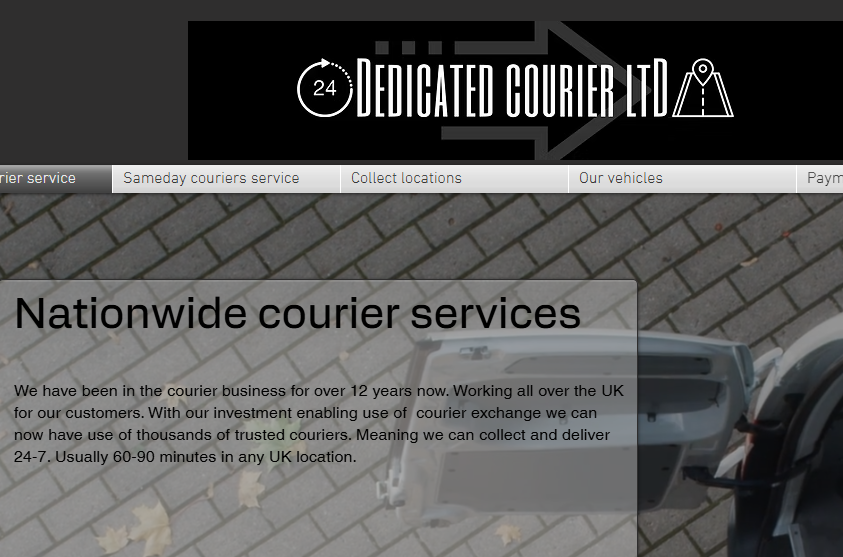
Testing a same-day or next-day promise doesn’t require new vans, new warehouses, or a new hire. It requires one reliable partner you can call when a pilot postcode needs to be proven out. Dedicatedsamedaycourier runs exclusive-use vehicles on urgent same-day, next-day, overnight, and pre-booked jobs, 24 hours a day, across the UK, with no co-loading and no waiting for a van to fill up elsewhere first.
[
That direct, single-consignment model is exactly what makes it useful for the incrementality testing covered above: book a dedicated vehicle for your highest-density pilot postcode, run it for four to six weeks, and measure the on-time rate and repurchase lift against your standard service before you commit any capital to a permanent fleet or warehouse. Its courier exchange network also gives you nationwide reach for the pilot without needing multiple carrier accounts. Check available courier vehicles for your job size, or get a quote directly through the dedicated courier service page to book your first test run this week.
Frequently asked questions
What are the most effective fast delivery strategies for 2026? Segmenting delivery promises by demand density, reducing stop time through pre-notification and digital proof of delivery, running a hybrid multi-partner network, and measuring cost per delivery against repurchase lift before scaling any faster promise.
How can small businesses improve delivery speed without big investment? Fix address validation at checkout, offer local collection points, set fixed courier pickup windows, and send templated dispatch confirmations. These cost little and often resolve more failed deliveries than new software.
Is same-day delivery always worth offering? Only where demand density supports it financially. In sparse postcodes, same-day promises usually cost more than they return; testing with incrementality data before committing is the safer route.
What technology gives the best return for improving delivery speed?
Sources
Recommended


Comments