
Explaining pallet transportation: a 2026 guide
TL;DR:
Pallet transportation consolidates goods onto standard pallets, reducing handling time and damage claims. Proper pallet selection, packing, and documentation are essential to control costs and ensure safety. Using correct methods enhances efficiency in multi-stop deliveries and international shipments.
Pallet transportation is defined as the process of securing goods onto standard pallets to create unitised loads that can be moved mechanically by forklifts, pallet trucks, and conveyor systems. This method transforms loose items into a single, manageable unit, and palletised shipping reduces loading and unloading time by 300%–500% while cutting damage claims by up to 40%. For logistics managers and business owners, understanding the pallet shipping process means controlling costs, reducing rejections, and keeping goods in transit safe. Key tools in this process include GMA pallets, the Bill of Lading, and shrink wrap techniques.
What is pallet transportation and why does it matter?
Pallet transportation, known in the industry as palletised freight, converts individual packages into a single unitised load. That consolidation is the foundation of modern freight logistics. Without it, warehouses rely on manual handling for every item, which multiplies labour costs and damage risk.
The GMA pallet measures 48x40 inches and accounts for 30% of all pallets produced globally. It is designed to fit two-across in a standard 53-foot trailer, making it the default choice for most UK and North American freight operations. The Europallet, or EUR/EPAL standard, measures 1,200x800mm and dominates European supply chains. Choosing the wrong pallet size for your trailer configuration wastes space and increases your cost per shipment.
Poor palletisation creates hidden costs at destination, including labour fees and damage claims. Treating every pallet as a standalone, robust unit from the point of packing is the single most effective way to prevent those costs.
What types of pallets are used in freight transport?
The two dominant standards are the GMA pallet and the EUR/EPAL Europallet. Both are built for four-way entry, meaning a forklift can approach from any side. This is not a minor convenience. Two-way entry pallets restrict forklift access and force manual repacking, which slows warehouse throughput and increases handling damage.
Pallet Type | Dimensions | Common Use |
GMA Pallet | 48x40 inches (1,219x1,016mm) | North America, UK general freight |
EUR/EPAL Europallet | 1,200x800mm | European supply chains |
UK Standard | 1,200x1,000mm | UK domestic distribution |
Half Pallet | 600x800mm | Retail, smaller consignments |
Load capacity and structural quality matter as much as size. A damaged or substandard pallet under a heavy load is a liability, not a cost saving. For international shipments, wooden pallets must carry the ISPM 15 stamp, confirming heat treatment to prevent the spread of pests across borders. Missing this mark causes quarantine holds and customs delays that cost far more than the pallet itself.
Pro Tip: Always inspect pallet condition before loading. A cracked block or broken deck board under a 500kg load will fail in transit, not in the warehouse.
How do you pack a pallet for safe shipping?
Packing a pallet correctly is where most damage claims originate or are prevented. The rules are straightforward, but they are frequently ignored under time pressure.
Place the heaviest items on the bottom layer, directly over the pallet deck.
Stack in columns, not in a pyramid. Column stacking transfers weight downward through the load. Pyramid stacking creates outward pressure that destabilises the unit.
Maintain zero overhang. No package should extend beyond the pallet edge, as overhang causes compression damage to adjacent freight and leads to delivery rejection.
Apply stretch film starting with at least 3 full rotations at the base, then spiral upward with 50% overlap, stretching the film to 200%–250% of its original length.
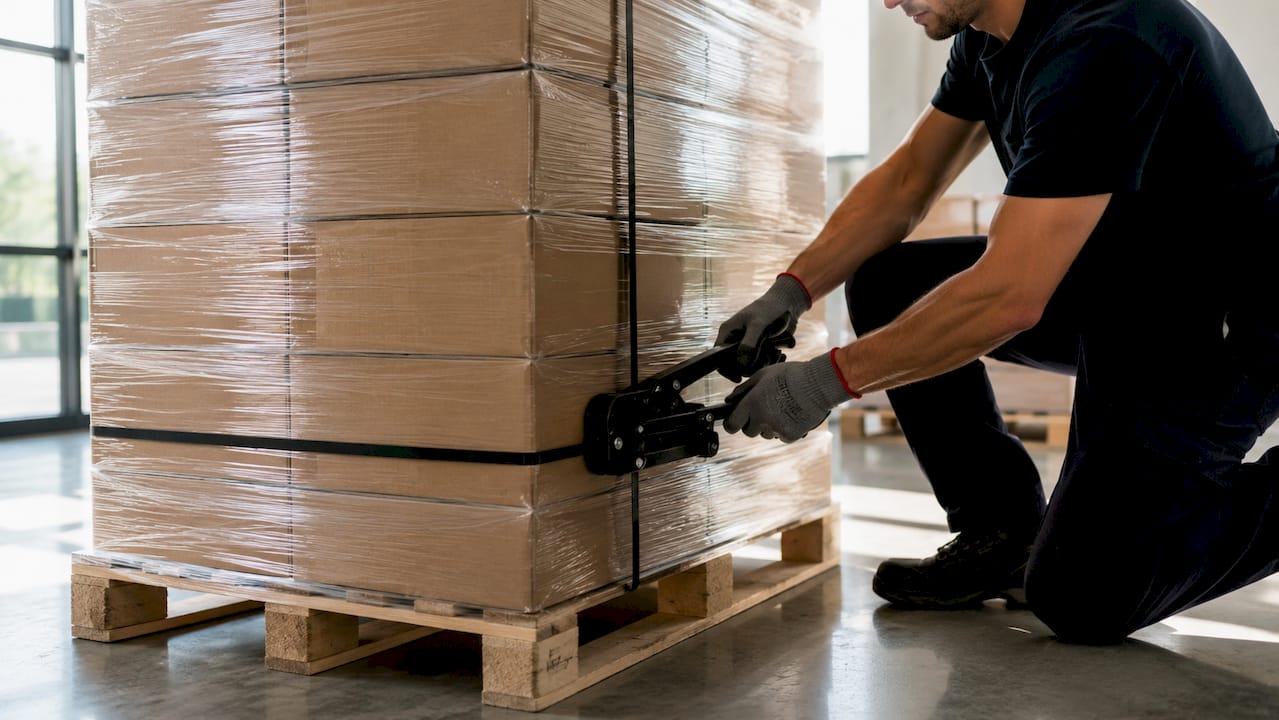
For loads exceeding 750kg, apply a minimum of 2 horizontal and 2 vertical straps using mechanical strapping equipment.
Failing to use mechanical strapping on heavy loads over 750kg is the most common cause of load failure during transport. Strapping is not optional for heavy freight. It is the difference between a delivered consignment and a damage claim.
Use edge protectors at the corners before applying strapping. They distribute strap tension evenly and prevent the strap from cutting into carton edges. Label all four sides of the pallet clearly, and waterproof labels if the shipment will pass through cold storage or outdoor handling areas.
Pro Tip: Clean, square pallets with flush content are safer and easier to stack than complex arrangements. Simplicity in packing is a professional standard, not a shortcut.
What transport methods affect pallet shipping efficiency?
The two primary shipping arrangements for palletised freight are Less-Than-Truckload (LTL) and Full-Truckload (FTL). LTL consolidates pallets from multiple shippers into one trailer, which reduces cost per pallet but increases handling touchpoints and transit time. FTL dedicates an entire vehicle to one consignment, which suits time-sensitive or high-value freight.
Beyond the choice of LTL or FTL, how pallets are loaded onto the vehicle directly affects safety and cost:
Place heavy pallets above the trailer’s axles to maintain vehicle stability and comply with road weight distribution regulations.
Use friction mats on flatbed trailers to prevent pallets sliding during acceleration, braking, and cornering.
Symmetrical loading on flatbed trailers is critical. Uneven weight distribution causes trailer tilt and increases the risk of load failure.
For multi-stop deliveries, load sequencing means placing the first delivery pallets at the rear of the trailer. This allows unloading without disturbing other freight and reduces handling damage across the route.
Load sequencing is a detail that many operators overlook until they experience a delayed multi-stop run. Getting it right at the point of loading saves significant time and reduces the risk of goods being moved unnecessarily.
Which factors determine the cost of pallet transport?
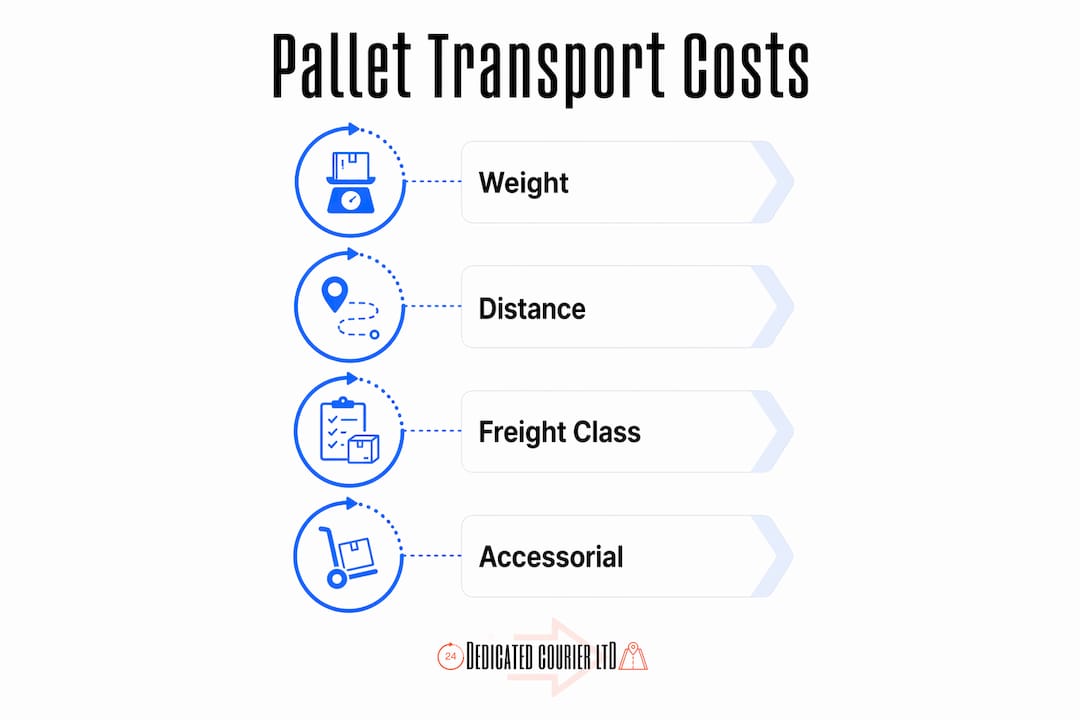
Pallet shipping costs are driven by four primary factors: weight, distance, freight class, and accessorial charges. Freight class is the factor most often misunderstood and most frequently responsible for unexpected invoices.
Cost Factor | What It Means | How to Control It |
Weight | Actual or dimensional weight, whichever is greater | Maximise load density to reduce dimensional weight |
Freight Class | Density-based classification affecting base rate | Stack denser loads to achieve a lower freight class |
Distance | Lane pricing between origin and destination | Consolidate shipments where possible |
Accessorial Charges | Fees for liftgate, residential delivery, fuel surcharges | Declare requirements accurately at booking |
Freight class is determined by density and directly affects the rate you pay. Stacking denser loads reduces freight class and lowers shipping rates. A pallet that is loosely packed with lightweight goods will attract a higher freight class than the same goods packed tightly. Proper pallet dimensions and stacking maximise trailer space and help control costs across your entire freight programme.
Avoid reclassification penalties by measuring and documenting pallet dimensions accurately before booking. Carriers that discover a discrepancy at the dock will reclassify the shipment and charge accordingly, often with an additional handling fee.
What documentation is required for pallet shipments?
The Bill of Lading (BOL) is the legal contract between shipper and carrier for every palletised consignment. Inaccuracies in the BOL lead to classification disputes, liability issues, and delayed payments. Every BOL must include accurate weight, dimensions, freight class, and any special handling instructions.
Key documentation and compliance requirements include:
Bill of Lading: Complete and accurate for every shipment, signed by both shipper and carrier.
ISPM 15 compliance: All wooden pallets used in international trade must carry the heat-treatment mark to clear customs without delay.
Label placement: Apply labels to all four sides of the pallet at a consistent height for scanner visibility.
Waterproofing: Protect labels on shipments passing through cold storage, outdoor staging, or wet loading docks.
Smart pallet systems with digital documentation and onsite inspections are becoming standard practice for high-value logistics operations. Digital BOL platforms reduce disputes by creating a timestamped record of pallet condition at collection and delivery. For businesses managing regular freight, adopting digital document transport procedures is a practical step toward reducing claims and improving carrier relationships.
Key takeaways
Effective pallet transportation requires correct pallet selection, disciplined packing, accurate documentation, and informed transport decisions to control costs and prevent damage.
Point | Details |
Pallet selection matters | Use four-way entry pallets and match dimensions to your trailer configuration to avoid wasted space. |
Packing discipline prevents claims | Zero overhang, column stacking, and mechanical strapping on loads over 750kg are non-negotiable. |
Freight class drives cost | Denser, well-stacked pallets attract lower freight class ratings and reduce your shipping rate. |
Documentation protects you | An accurate Bill of Lading and ISPM 15 compliance prevent disputes, delays, and customs holds. |
Load sequencing saves time | Place first-delivery pallets at the trailer rear to reduce handling on multi-stop routes. |
What i have learned after years of watching pallet shipments go wrong
The most consistent mistake I see from logistics managers is treating the pallet as an afterthought. The pallet gets loaded last, wrapped quickly, and labelled as an afterthought. Then the damage claim arrives and everyone is surprised.
The businesses that consistently avoid freight damage and rejection treat every pallet as a finished product before it leaves the warehouse. That means checking pallet condition, verifying dimensions against the BOL, and confirming the stretch film has been applied correctly, not just draped over the load.
The other area where I see real money lost is freight class. Managers book shipments based on product weight alone and then receive an invoice with a reclassification charge. Measuring pallet dimensions accurately and understanding how density affects class is not complex. It just requires a process. Build that process once and it pays for itself on the first reclassified shipment you avoid.
Documentation accuracy is the third pillar. A BOL with incorrect weight or dimensions is not a minor administrative error. It is a liability that can delay payment, trigger a dispute, and damage your carrier relationship. Get it right at the point of booking.
— andrew
How Dedicatedsamedaycourier supports your pallet transport needs
Dedicatedsamedaycourier provides dedicated same-day and next-day pallet delivery across the UK, with exclusive vehicle allocation ensuring your freight is not consolidated with other shippers’ goods. That means fewer handling touchpoints and a lower risk of damage in transit.
[
The service operates 24/7 and covers a full range of courier vehicles suited to pallet transport, from small vans for single-pallet consignments to larger vehicles for multi-pallet loads. For time-sensitive freight where LTL consolidation is not an option, Dedicatedsamedaycourier’s same-day courier service offers a direct, reliable solution with nationwide coverage. Request a quote online, by phone, or by email for a tailored delivery arrangement.
FAQ
What is pallet transportation?
Pallet transportation is the process of securing goods onto standard pallets to create unitised loads for mechanical handling and freight shipping. It reduces loading time, minimises damage, and improves cost efficiency across the supply chain.
What size pallet is standard for UK freight?
The UK standard pallet measures 1,200x1,000mm, while the EUR/EPAL Europallet at 1,200x800mm is widely used across European routes. The GMA pallet at 48x40 inches is common for UK operations with North American trade links.
How many straps are needed for a heavy pallet?
Loads exceeding 750kg require a minimum of 2 horizontal and 2 vertical straps applied with mechanical strapping equipment. This is the most commonly overlooked requirement and the leading cause of load failure during transport.
What is a bill of lading and why does it matter?
The Bill of Lading is the legal contract between shipper and carrier, detailing weight, dimensions, freight class, and handling instructions. Inaccuracies lead to reclassification charges, liability disputes, and delivery delays.
Do wooden pallets need special certification for international shipping?
Yes. Wooden pallets used in international shipments must carry the ISPM 15 heat-treatment stamp. Without it, pallets are subject to quarantine holds and customs delays at the point of entry.
Recommended


Comments