
Why courier reliability matters for urgent UK businesses
Updated: May 14

Courier reliability involves on-time delivery, success rates, proof of delivery, and secure handling.
Unreliable courier services can cause missed deadlines, financial penalties, and data breaches.
Businesses should choose couriers with transparent data, real-time tracking, GDPR compliance, and contingency plans.
Most business owners assume courier problems mean late deliveries. That assumption is costly. Failed first-time delivery attempts, poor complaint handling, and data security failures cause just as much disruption as simple delays, yet they rarely get the attention they deserve. This guide cuts through the noise to explain what reliable courier performance actually looks like, how to measure it, and what practical steps UK businesses can take to protect their operations when urgent document and parcel deliveries are on the line.
Table of Contents
Key Takeaways
Point | Details |
Reliability goes beyond speed | Courier reliability means consistent, secure, and documented delivery, not just fast drop-offs. |
Business risks are high | Unreliable couriers can cost your business money, reputation, or even cause regulatory breaches. |
Smart selection is essential | Choose partners with published performance data, complaint resolution, and clear tracking. |
Multi-carrier strategies increase security | Using more than one trusted courier reduces delays and increases resilience for urgent needs. |
Understanding reliability in the UK courier sector
Reliability in courier services is not simply about whether a parcel arrives on time. For businesses sending urgent documents or goods in transit, it covers several measurable factors. On-time delivery (OTD) is the most commonly cited metric, measuring whether a shipment reaches its destination within the agreed window. First-time delivery success rate (FTDSR) tracks how often a delivery is completed without a failed attempt. Proof of delivery (POD) confirms receipt with a signature or digital record. Zero-defect handling means goods arrive undamaged and secure.
Understanding these terms matters because why reliable couriers matter goes well beyond speed. A courier can be technically on time but still fail the delivery because no one was available to sign, or because the driver left no card and marked the job complete.
The statistics from the sector are sobering. 14% failed first-time deliveries, 12% of deliveries delayed by driver shortages, and 68% of users reporting various service issues paint a picture of an industry still struggling with consistency. These figures are not outliers. They reflect systemic gaps in how many courier providers operate.
“The data shows that most courier complaints are not just about late parcels. Failed attempts and poor resolution processes are equally damaging to business relationships.”
The key misconception to address here is that delays are the primary problem. In practice, failed delivery attempts and slow or dismissive complaint resolution processes often cause more disruption to business operations than a delivery that arrives an hour late.
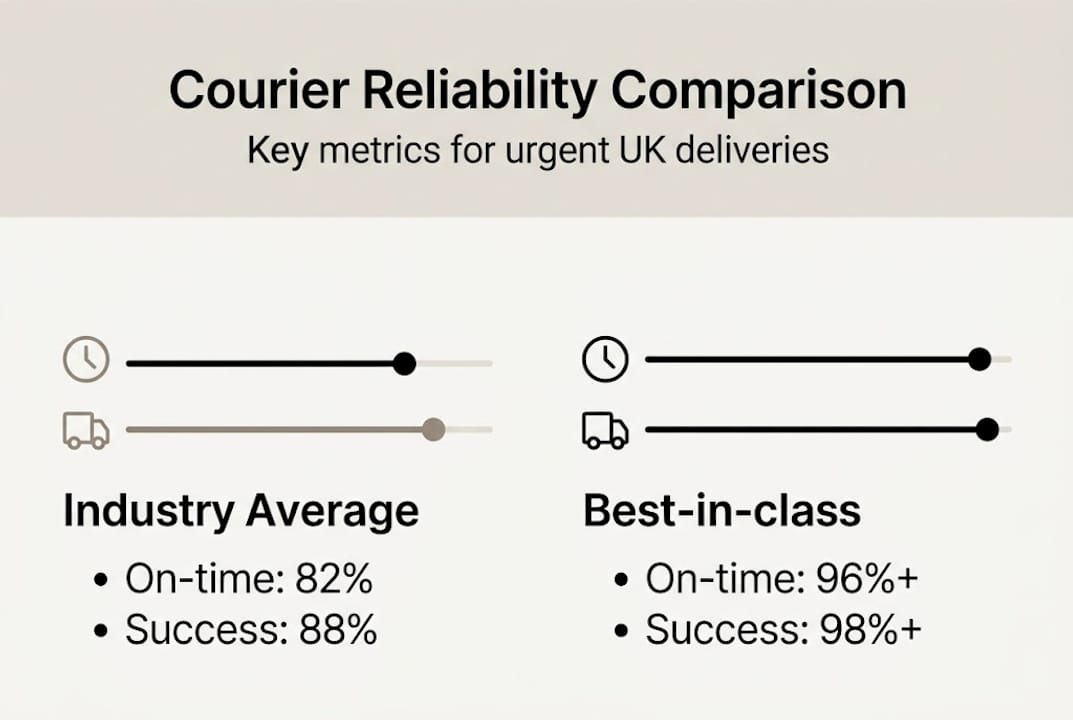
Reliability metric | Industry average | Best-in-class standard |
On-time delivery (OTD) | 82% | 96%+ |
First-time delivery success (FTDSR) | 86% | 98%+ |
Complaint resolution rate | 61% | 90%+ |
Proof of delivery provided | 74% | 99%+ |
How unreliable courier services harm UK businesses
With the metrics in mind, it is clear that unreliability is more common than many expect. Here is how those failures can directly threaten your business.

68% of UK courier users report service issues, with 28% of those issues related directly to delivery delays. The remaining 40% involve failed attempts, lost items, damaged goods, and poor complaint handling. For businesses, these failures translate into real consequences.
Direct impacts include:
Missed legal or contractual deadlines leading to financial penalties
Lost contracts when clients lose confidence in your delivery chain
Staff time wasted chasing couriers or re-arranging failed deliveries
Increased operational stress across teams managing time-sensitive shipments
Indirect risks are equally serious. When confidential documents go missing or are delivered to the wrong address, GDPR (General Data Protection Regulation) obligations come into play. A data breach caused by a courier failure can result in regulatory fines and reputational damage that far outweigh the cost of the delivery itself. The benefits of reliable courier services become very apparent when you consider these downstream risks.
For businesses sending sensitive materials, following document delivery best practices is not optional. It is a basic operational requirement.
Pro Tip: Before committing to any courier provider, ask specifically how they handle failed delivery attempts and what their complaint resolution timeline looks like. A provider that cannot answer clearly is a provider to avoid.
Key factors for reliable courier selection
So, what should you demand from a truly reliable courier? This section gives a clear, actionable framework to steer your vetting process.
Businesses should prioritise couriers with public OTD and FTDSR data, effective complaint scores, and robust contingency plans. If a provider cannot share these figures, that is itself a red flag.
Here is a numbered checklist for evaluating any courier before you commit:
Request published OTD and FTDSR statistics, not just marketing claims
Confirm real-time tracking is available for every shipment
Verify proof of delivery (POD) is standard, not an optional add-on
Check the level of goods in transit insurance and hire and reward cover
Confirm GDPR-compliant handling procedures for sensitive documents
Ask about contingency plans for driver shortages or vehicle breakdowns
Review their complaint resolution process and average response times
The table below shows how typical providers compare to best-in-class services across the factors that matter most to urgent business deliveries.
Selection factor | Typical provider | Best-in-class provider |
Published delivery data | Rarely available | Publicly accessible |
Real-time tracking | Basic or delayed | Live, end-to-end |
Contingency planning | Informal or absent | Documented and tested |
GDPR compliance | Assumed | Verified and documented |
Complaint resolution | Days or weeks | Within 24 to 48 hours |
For businesses that regularly rely on urgent deliveries, the dedicated courier guide offers further detail on choosing the right vehicle type and service level for your specific needs.
Putting reliability into practice: smart strategies for UK businesses
Once you know what to look for, here are effective, proven strategies to operationalise reliability and protect your business.
Multi-carrier strategies boost resilience for urgent deliveries without sacrificing speed or security. Relying on a single courier provider creates a single point of failure. Businesses that maintain relationships with two or three vetted providers are far better placed to handle sudden demand or service disruptions.
Practical steps to build a resilient courier arrangement include:
Establish written contracts with SLAs (service-level agreements) that define acceptable OTD rates and complaint resolution timelines
Maintain at least one backup courier vendor who can be activated at short notice
Log every delivery incident, including failed attempts and delays, to identify patterns over time
Monitor delivery success rates and customer feedback scores monthly, not just when problems arise
Ensure all couriers handling sensitive documents meet current GDPR and data protection standards
Sustainability is also becoming a reliability factor. Couriers investing in cleaner fleets and compliant operations tend to face fewer regulatory disruptions. To optimise courier logistics effectively, sustainability and compliance should be part of your evaluation criteria, not an afterthought. The local delivery checklist is a useful starting point for reviewing your current arrangements.
Pro Tip: Schedule a quarterly review of your courier providers. Compare their delivery data against your SLAs and look for any decline in FTDSR or complaint resolution scores before problems escalate.
Why true reliability is more than just making promises
Many courier providers lead with speed and coverage in their marketing. Those are important, but they are not the full picture. We see businesses make the mistake of choosing a courier based on a headline delivery time, only to find that the provider has no documented contingency plan or cannot produce verified delivery data on request.
The firms that genuinely protect their clients demand independent metrics and hold couriers accountable through regular reviews. Over-reliance on a single provider or basic tracking alone is a risk that many businesses only recognise after a costly failure. The dedicated courier advantages of exclusive vehicle use, documented chain of custody, and real-time accountability are what separate a genuine reliability partner from one that simply promises to try.
Explore trusted same-day courier solutions
If your business cannot afford courier uncertainties, it is worth knowing that proven delivery partners do exist. DedicatedSameDayCourier.co.uk offers sameday courier services built around the reliability standards this guide outlines.
[

From urgent documents to time-sensitive parcels, every delivery uses a dedicated vehicle with full tracking and appropriate insurance cover. A range of van courier options is available to match your load size and urgency. For businesses needing consistent, verifiable delivery performance across the UK, the nationwide courier service is available 24 hours a day. Request a tailored quote online, by phone, or by email.
Frequently asked questions
How does courier reliability directly affect urgent business deliveries?
Failed first-time deliveries and delays impact 68% of UK courier users, meaning unreliable services directly risk missed deadlines, financial penalties, and damaged client relationships for businesses.
What should businesses check when choosing a reliable courier?
Look for public delivery statistics, real-time tracking, secure handling, insurance cover, GDPR compliance, and robust complaint resolution. Businesses should prioritise couriers publishing OTD and FTDSR data alongside verified complaint resolution scores.
Is multi-carrier use better for urgent, reliable delivery?
Yes, using multiple vetted couriers increases resilience and ensures urgent shipments are not delayed by one provider’s problems. Multi-carrier strategies boost resilience without sacrificing speed or security.
How does courier reliability relate to GDPR compliance in the UK?
A reliable courier minimises the risk of data loss or exposure for confidential documents, helping businesses avoid GDPR breaches. UK GDPR fines can reach £12 million, making secure courier handling a legal necessity, not just a preference.
Recommended


Comments